When you start building your game world, the vision comes quickly – the characters, the environments, the feel of the gameplay. But turning that vision into polished 2D or 3D art takes real investment, and in 2026 the market looks quite different from even a few years ago.
AI-assisted tooling, a more competitive outsourcing landscape, and rising player expectations have all shifted what studios charge – and what you get for your budget. The scale of modern productions makes this clear: CD Projekt’s post-launch crisis over Cyberpunk 2077 – a game that cost over $316 million to develop and market – showed just how much is at stake when budgets spiral. Meanwhile, studios like Eidos Montreal have been openly rethinking their production models to make single-player games financially viable again. The pressure to spend smart has never been greater.
The good news for independent developers is that outsourcing high-quality 2D art and 3D art design has never been more accessible. Whimsy Games has delivered art for more than 50 shipped titles across mobile, PC, and console platforms. In this guide, we break down the real cost of 2D and 3D game art in 2026 – covering concept art, characters, environments, and animation – and show you how to plan your budget without compromising on quality.
The first factor that determines the game’s cost is the dimension: 2D or 3D. The difference between 3D and 2D game art is colossal. Thus, it’s crucial to know both in detail to choose the correct one.
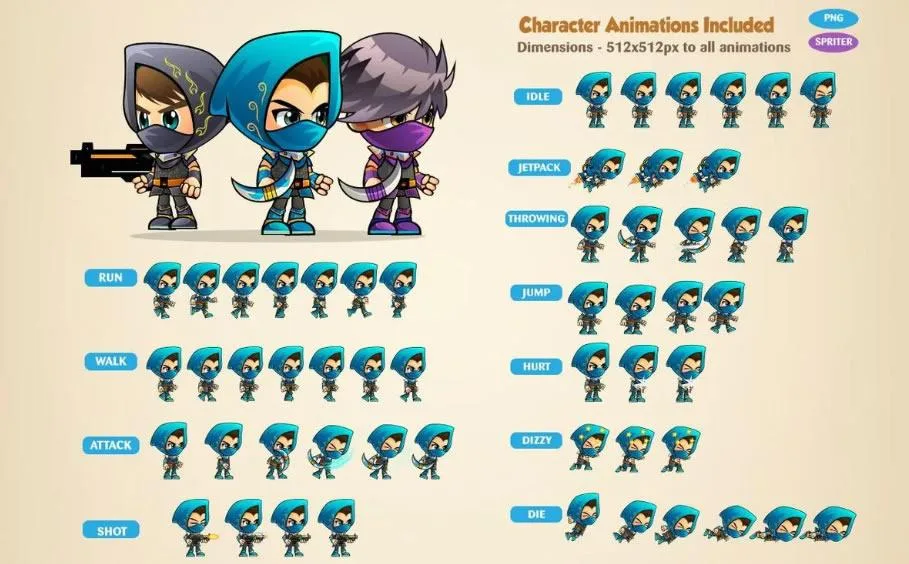
2D art game has no physical depth. The shadows and textures trick our eyes, creating the illusion of three-dimensionality, but a 2D image on a screen has only two axes of motion. Characters may go right or left, up or down, making the game simple and the gameplay shorter. The animation of flat images is also designer hocus pocus. Since 2D objects can’t move along a surface, any new posture or clothing requires a separate drawing or a sprite.
In 3D art, you add depth to height and width. Design software programs like Poser, Daz Studio, and Maya calculate the 3D model’s characteristics and allow you to rotate it 360 degrees or view it from the inside. This means the Assassin game character can walk around the building and explore it because environments and assets have a mathematical representation of physical volume.
There is a competition between 2D art and 3D art. You might think that modern 3D art techniques are gradually replacing 2D drawing, but both approaches have advantages and disadvantages. Let`s compare how 2D and 3D perception is used in different games.
Advantages of 2D art for games
Simple gameplay. Two dimensions are the best options for simpler games. Perhaps it won`t be stunning but it doesn`t rule out popularity. Examples like chess.com or Boardarena are the most persuasive.
Lower development cost. Usually, the cost of 2D art is half that of 3D for the same task. And you don`t worry about developing such a game and endless feature updates.
Advantages of 3D art for games
Extensive gameplay. With three dimensions there is a broader range of opportunities for the movements and interactions of the character and the game world. The gameplay may last for hours and the players won`t get bored.
Realism. 3D objects look cool because the palette is brighter, the animation is eye-catching and the environment looks real. The camera that flips 360 degrees and shows wrinkles on the healer`s face or the carpets on the floor of the castle gives a feeling of the real world.
Specialties Of 2D Game Art
The more details of your projects you give to the artist, the more precise will be his estimation of the 2D art cost. The price f the game design will depend on the complexity of your universe and will probably include the concept, characters, their clothes, number of accessories or weapons, layouts of the environment, and the animation.
Vector or Raster
There are two main types of 2D images: raster graphics and vector graphics.
A raster graphic’s basis is made up of flat, tiny dots – pixels – that form the entire image. These images are saved as .jpg or .webp files that you are surely familiar with. When you zoom in on a raster image, you’ll notice that it becomes hazy and small square dots appear.
In a vector image, the formulas construct the points, shapes, and colors that you see. The most common vector file formats are .ai (for Adobe Illustrator), .eps (for Encapsulated PostScript), and .svg (Scalable Vector Graphics). A vector image will remain smooth when you zoom in or scale it up.
There is a great tradition of 2D pixel art, from Doom to Minecraft, which shows that raster graphics will find devoted players alongside their vector counterparts.
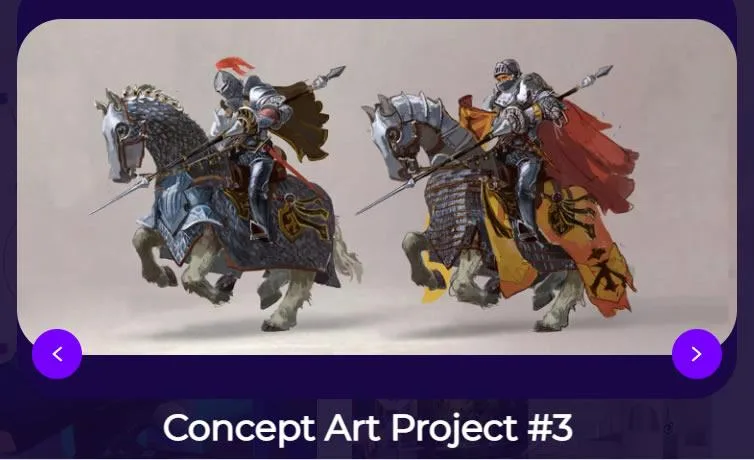
If you decide to hire a freelancer for the concept art, the rates in Europe range from $25 to $100+ per hour.
Note that the game’s concept may require several iterations and adjustments until it aligns with your vision. The designer price usually includes the number of free changes, while additional drawing alterations will require an extra fee.
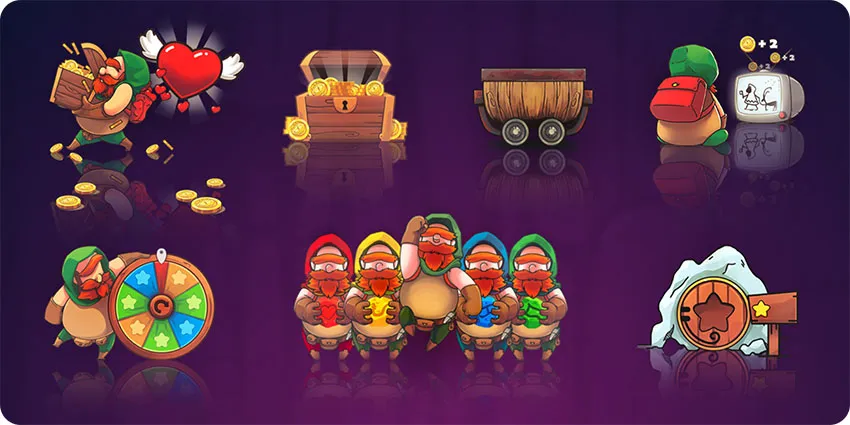
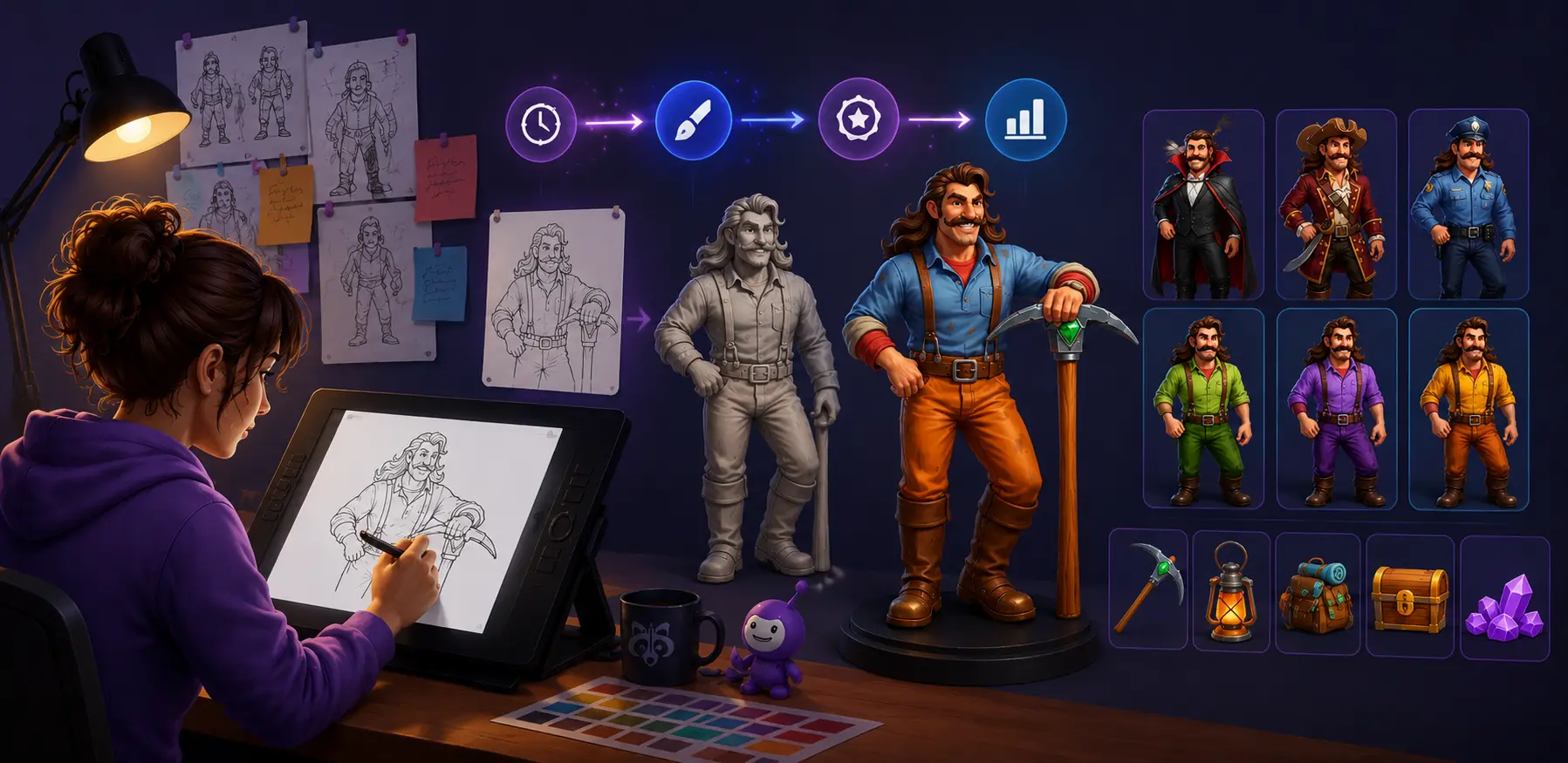
The game’s characters are the most active and detailed elements. Their appearance has to be flawless because the player identifies with the image on the screen and, hopefully, becomes attached to the hero.
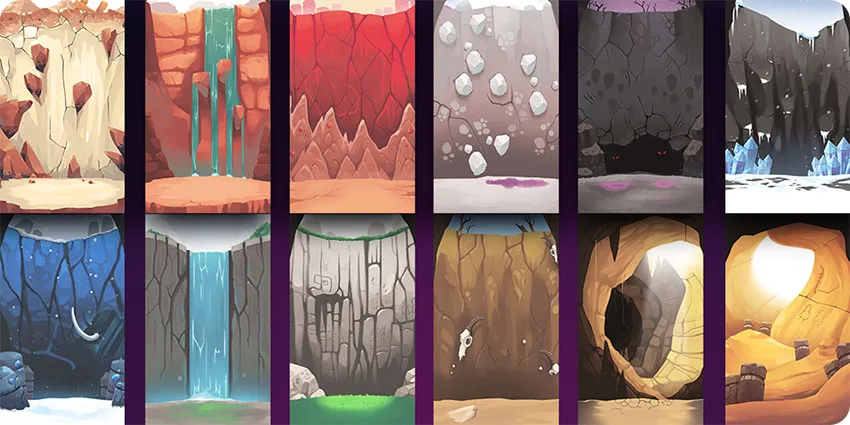
For example, the dwarfs in the Magic Cave game by Whimsy are cute and funny. We have added several postures, such as a dwarf with a treasure chest or someone watching TV, to liven them up.
Assets
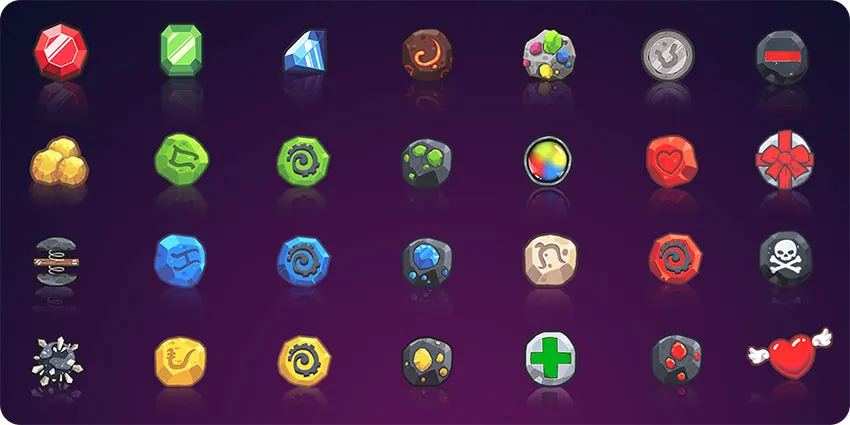
Weapons, trophies, amulets, and other engaging assets that beckon the player from level to level are designed separately. Look at the shiny gemstones from the dwarfs` cave and think about the assets you need for your game.
Environment
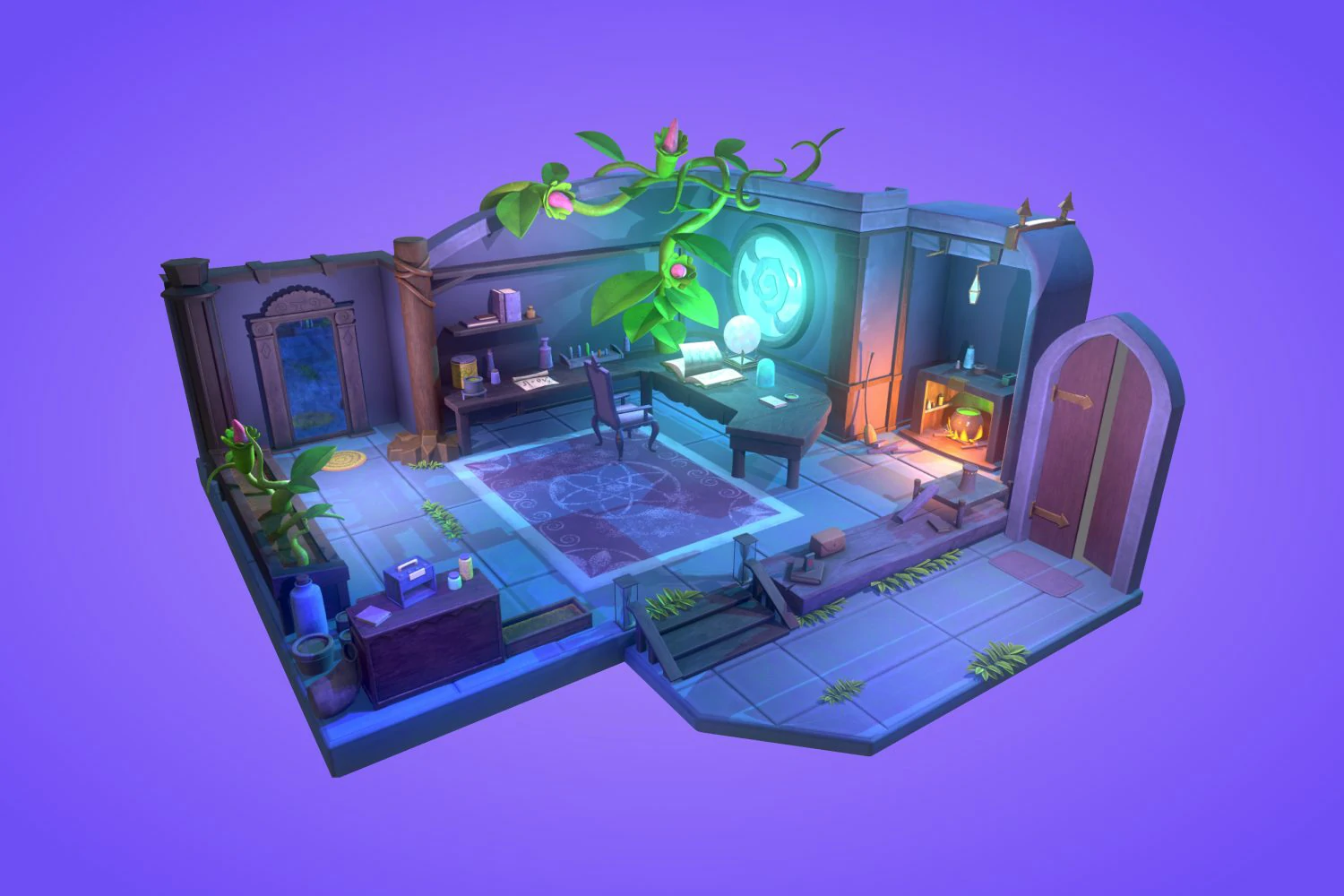
Environmental design is a discipline where artists embody entire worlds with nature, architecture, and numerous game locations. Your wildest ideas can turn into eclectic, unforgettable landscapes or puzzling dungeons with the help of the experienced Whimsy team.
Animation
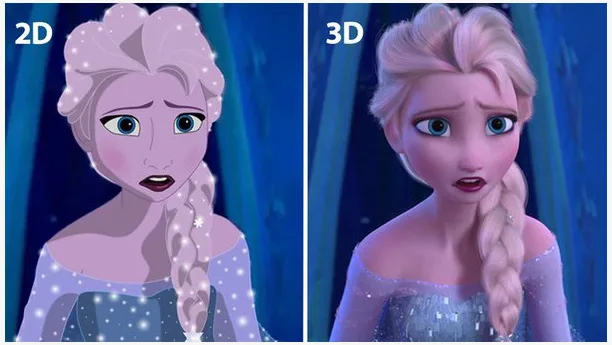
You can recall the examples of 2D animation in classic Disney works like 101 Dalmatians or Tarzan and compare them to 3D animation from Pixar in Finding Nemo.
2D animations are almost half the price of 3D animations. They are easy to make and therefore faster to produce. You can get the result for your game done in six-eight weeks.
You can also quickly adopt 2D animations to banners, labels, posters, infographics, business cards, web materials, and other promotional printables. Meanwhile, a 3D model needs a rendering to make a flat shot of the scene.
However, 2D animations can be pretty primitive. The switch between the sprite sheets when the character moves is not as realistic as in 3D videos.
Factors Which Influence 3D Game Art Cost
2D art requires more traditional drawing skills, while 3D needs special software like Lightwave, 3D Max, Blender, and computer power to embody the game project. Simply put, 3D artwork is lines of code creating marvelous game visualizations. The technical complexity of the project defines the cost of an art 3D game.
Modeling method
All 3D shapes are made of tiny surface elements called polys. At the beginning of polygonal modeling, characters, cars, trees, and buildings look like a mesh of small rug pieces stitched together in a digital patchwork.
High-poly objects contain many polygons, which add detail and enhance the model’s realism. High poly is essential for game characters and less important for assets and environments.
Low-poly objects need fewer polygons. They are good for basic models with low levels of detail and let you reduce expenses when hiring a 3D art company.
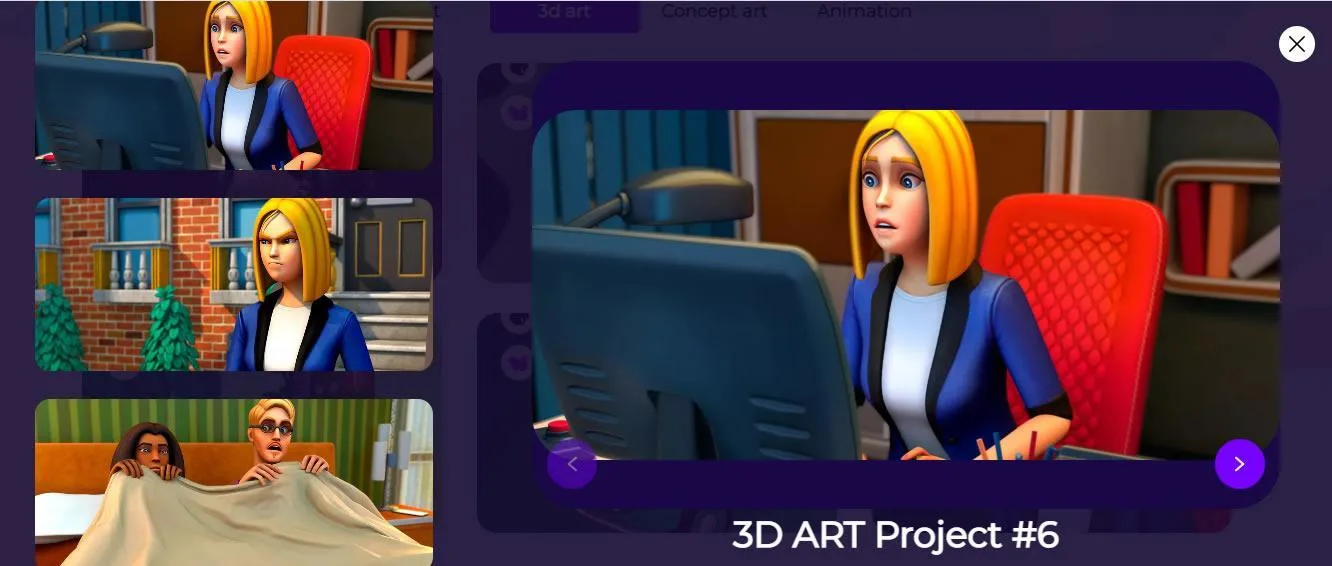
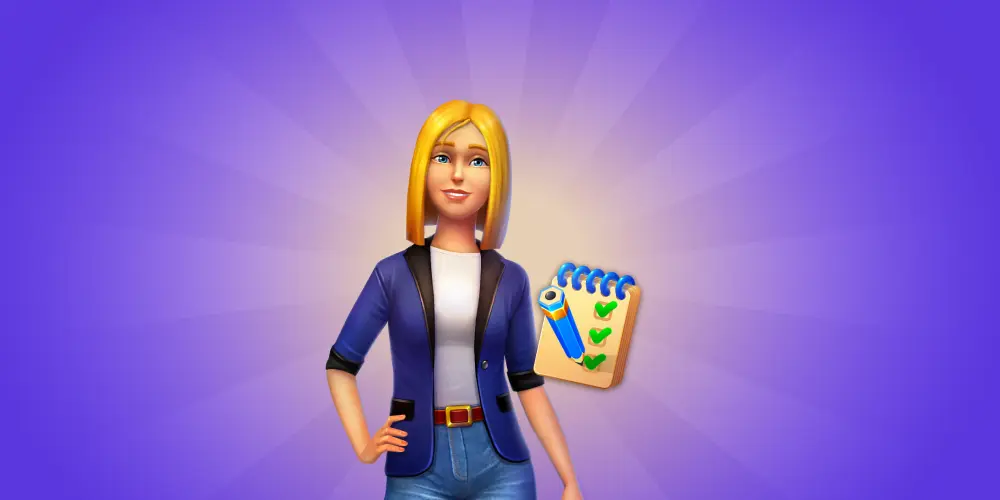
You can recognize polygonal modeling in the features of game characters. In the case of Whimsey Art Project N6, our experienced designers edit multiple polygon corners to make the blond secretary’s face look worried.
Spline modeling uses another principle. Instead of polys, numerous curves and points stand for the basic elements of a 3D shape. Such models look impressive but may be difficult to edit due to the mathematical formulas and calculations involved. The cost of spline modeling is often higher due to the computer, software, and complexity of the work.
3D art creation stages and tools
A 3D designer continuously switches between software tools at each stage of the 3D art creation process, including sculpting, texturing, rigging, skinning, rendering, and animating.
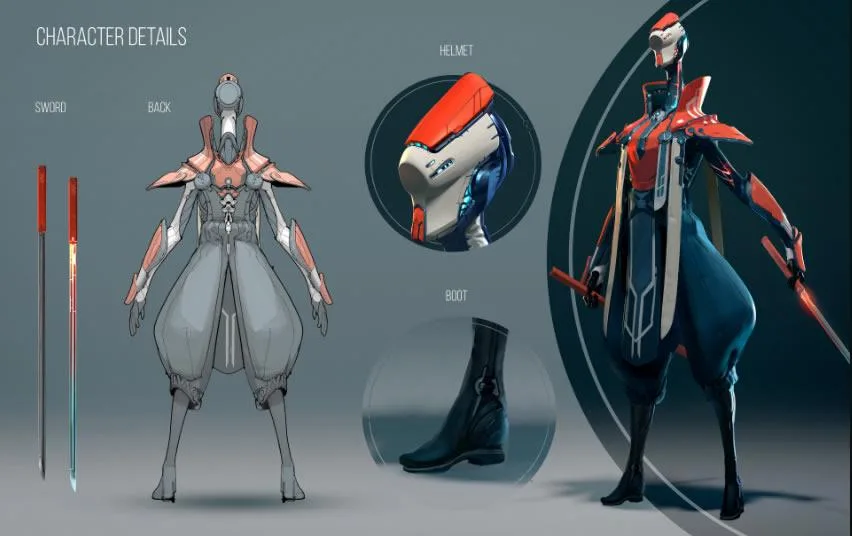
For example, overpainting is one of the last stages in which the designer adds masks for glossiness and surface reflection from the surface color. In some projects, overpainting takes up to 30% of all the work, like in the model below.
Many artists use overpainting in ZBrush, but the final .fbx file loses polypaint when exported to 3ds Max. However, Maya correctly accepts ZBrush overpainting, and you can then re-export the polypaint to 3ds Max for rendering.
Such enchanting detailing and computer processing take hours of a designer’s work. You can find more fascinating cases and professional descriptions of 3D modeling nuances on the ArtStation platform, but the main principle in estimating the 3D game art would sound like, ‘More detail means more money.’
3D animation moves images around 3D spaces and looks stunning like the Avatar movie or Assasin Crid game. However, the cost of such production may vary from $10,000 to $20,000 per minute for higher-quality videos.
NFT
Creating 3D models for the NFT game differs slightly from that in traditional games. Characters and assets should be developed on a blockchain basis so that players can buy and sell them. The cost of NFT models on freelance exchanges ranges from $75 to $200 per hour.
The Basic Formula To Calculate 2D Art And 3D Art Cost
As a rule, 3D art costs more than 2D alternatives for the concept, environments, and characters. The price tag for 2D graphics is anywhere from $50 to several thousand dollars. Meanwhile, 3D model development starts at $1000 for a game character and can go up to several hundred thousand dollars.
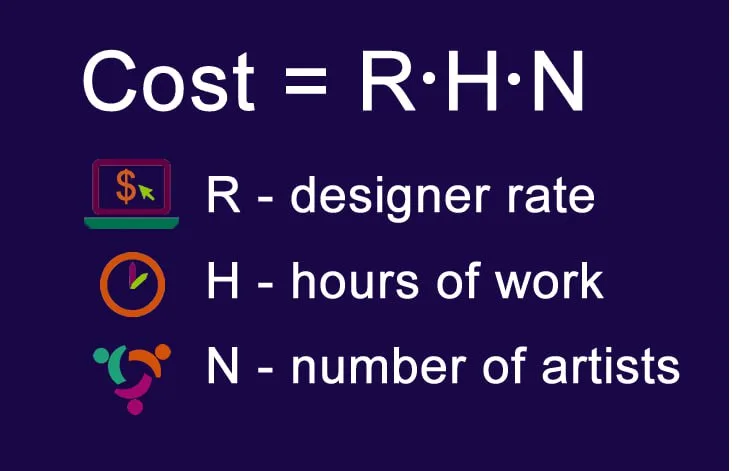
The general formula for calculating the price of 2D and 3D art includes the designer rate, hours of work, and the number of artists on your project team.
Additional expenses can arise due to the following factors
Delivery time. A 2D freelancer or 3D game art outsourcing studio fee would differ in case you need the result for tomorrow, in three days, or a week.
Editing. A small adjustment, such as flipping the image or swapping a single color, may not require an additional payment. But anything that requires more complex redrawing will incur an extra fee.
Game engine specialties. Game art for the Unity engine can be significantly different from the projects for Godot or Unreal Engine 4. The last type will take much longer and cost more.
Reference Concept Artists’ Rates
When choosing a design company, it’s reasonable to estimate the art cost relative to other market propositions. You could take the rates of concept art services in Whimsy Games as a reference for your research.
Concept designer rates, $ per hour
Entry level
Intermediate
Expert
2D Concept art
$15
$25
$35
3D Concept art
$15
$27
$40
Choosing a Game Art Outsourcing Studio Defines Your Result
The case of Hellblade: Senua’s Sacrifice proves that high-quality games can be made on smaller budgets and smaller teams. Ninja Theory’s UK-based development studio created a hit with a production cost under $10 ml, with a team of around 20 people. A short single-player game looked fascinating, won numerous awards, and was a financial success. How is this possible?
The key factor for the Hellblade miracle was a team of top professionals passionate about their work. In their case, a single person worked across several disciplines and served as a substitute for two or three narrow specialists. The precedent shows again that the people you work with define your results.
Whimsy Games has more than 15,000 hours of experience creating 2D and 3D concepts, characters, and environments for games. Our team has numerous projects in low-poly and middle-poly art, sculpting for 3D printing, rendered images for isometrics, and much more. If you have a great idea for a game, we have the prof’s team to embody it into comprehensive game art.
Get in touch
To make your gaming ideas in reality
Table of contents
FAQ
What is 3D art design?
3D art needs special software like Maya, 3D Max, or Blender, computer power, and skills to embody the game project. Technically speaking, 3D artwork is a set of 1s and 0s in a code, which assembles into marvelous game visualizations through polygonal modeling, sculpting, texturing, rigging, skinning, rendering, and animating.
How much does 2D art cost?
The price of the 2D game design will depend on the complexity of your universe and will include the cost of the concept, characters, environment, and animation. The general formula to calculate the price of 2D art includes the designer rate, hours of work, and the number of artists in the team within your project
How much does 3D art cost?
3D designer continuously switches between different software tools such as Maya, 3D Max, Blender, Zbrush, and Photoshop in each stage of the 3D art creation process. The technical complexity of the project defines the cost of 3D art. The general formula to calculate the price includes the designer rate, hours of work, and the number of artists in the team within your project.
Which is cheaper 2D or 3D animation?
The fidelity of 3D models takes hours of the designer`s work and makes it two times more expensive than the 2D art alternatives.
What’s harder 2D or 3D art?
Both 2D and 3D dimensions have their special difficulties and tricks. 2D development requires more drawing skills. At the same time, creating 3D games implies more computer competence and special software.
I'm a CEO and a Co-Founder of Whimsy Games. Before that, I advanced my expertise in engineering, management, traffic marketing, and analytics working for large game development studios with a $1M+ monthly income. With a clear vision of how game development should work, I run Whimsy Games, being responsible for the marketing and sales of our products and services.
Latest Posts
We at Whimsy Games can create any character, background, or object you need to make your mobile game stand out from others.