
Full-Cycle vs Co-Development: Choosing the Right Game Development Model in 2026
The way games are built has changed significantly over the past few years, and by 2026, the question of how you develop a game has become just as important as what you are building. Rising production costs, higher player expectations,longer post-launch support cycles, and increasing technical complexity have forced studios and startups to rethink their approach to collaboration.
Today, choosing between a full-cycle development model and co-development is no longer a purely operational decision. It is a strategic choice that affects ownership, flexibility, risk distribution, and the project’s long-term sustainability. Understanding the fundamental differences between these models is essential for making an informed decision.
Why the game development model matters in 2026
In the early stages of the industry, outsourcing was often used as a short-term solution to fill production gaps. In 2026, it has become integral to the planning, building, and support of games over time.
Studios now operate under tighter budgets and timelines while being expected to deliver higher-quality experiences across multiple platforms. At the same time, many teams want to retain creative control and protect their intellectual property. As a result, the choice between full-cycle development and co-development directly influences not only production efficiency but also a project’s resilience to change.
What full-cycle game development means today
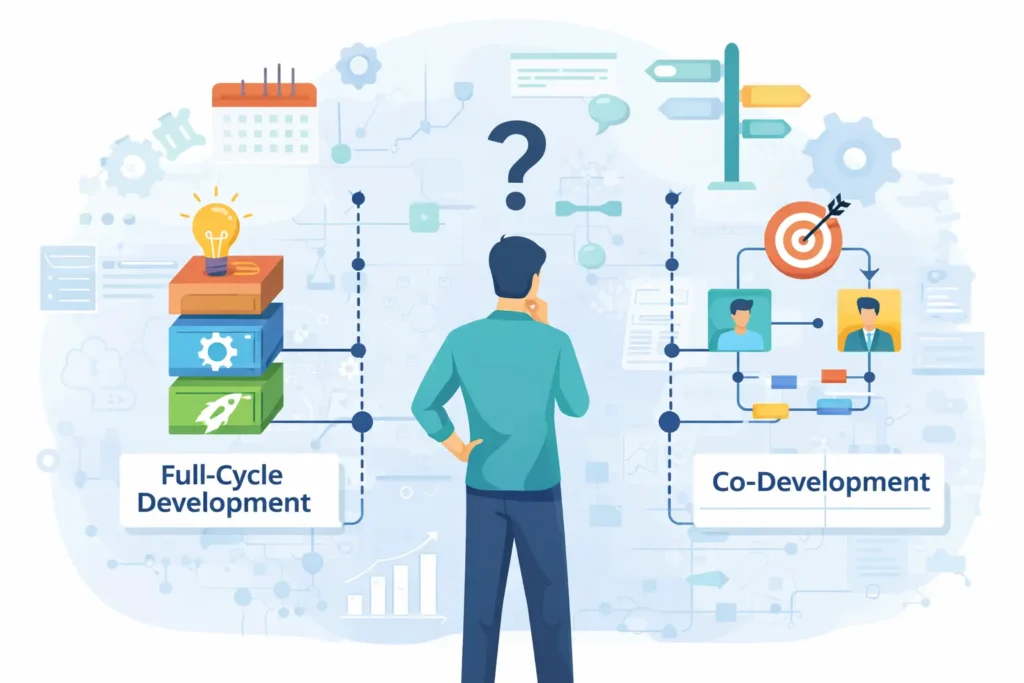
Full-cycle game development typically refers to a model in which a single external studio is responsible for the entire production process, from early concept and pre-production through development, launch, and, often, post-launch support.
In 2026, this model is most effective when:
- A client wants a clearly defined scope and timeline,
- Internal production resources are limited or unavailable,
- The project requires centralized decision-making,
- Speed and predictability are higher priorities than flexibility.
A full-cycle game development company usually takes ownership of execution across design, engineering, art, and quality assurance, providing a relatively straightforward production pipeline. For many teams, this simplicity is the main advantage.
However, the limitations of full-cycle development become more visible as projects grow in complexity. Because responsibility is concentrated on one side, changes in direction can be costly, and the original scope and assumptions may constrain long-term iteration.
What game co-development looks like in practice
Co-development in game development is often misunderstood as simple task distribution or staff augmentation. In practice, it is a collaborative model built on shared responsibility and integrated decision-making.
In a co-development setup:
- Internal and external teams work together on the same product,
- Ownership is distributed across specific systems or features,
- Production decisions are made collaboratively,
- Communication is continuous rather than milestone-based.
This model works particularly well for teams that already have internal leadership or a clear product vision but need additional capacity or specialized expertise. Co-development allows studios to scale production without losing strategic control, making it a common choice for long-term or live projects.
The main challenge of co-development lies in coordination. Without a clear collaboration framework, shared ownership can easily turn into blurred responsibility.
Full-cycle vs co-development: key differences
While both models are widely used, their implications differ significantly.
Ownership and responsibility
Full-cycle development centralizes responsibility within one external team. Co-development distributes ownership across internal and external contributors.
Creative control
Full-cycle projects often require earlier commitment to creative decisions. Co-development allows for more iterative design and shared creative input.
Speed versus flexibility
Full-cycle development can be faster at the start due to its streamlined structure. Co-development offers greater flexibility when priorities shift during production.
Scalability
Scaling a full-cycle project usually involves renegotiating scope. Co-development enables gradual scaling by expanding or reducing external involvement.
Risk distribution
In full-cycle models, production risk is transferred mainly to the vendor. In co-development, risk is shared, which can lead to better alignment but requires stronger internal management.

Choosing the right model for your team
There is no universally correct choice. The optimal model depends on the team’s structure, experience, and long-term goals.
- Early-stage startups often benefit from full-cycle development when internal production capabilities are limited.
- Indie studios may prefer co-development to retain creative control while scaling selectively.
- Mid-size teams frequently adopt hybrid approaches, combining internal leadership with external co-development.
- Publishers and live-service teams favor co-development for long-term content updates and technical scalability.
Understanding internal strengths and constraints is often more important than comparing external offers.
Common mistakes when choosing a development model
One of the most common mistakes is selecting a model based on convenience rather than suitability. Teams often choose full-cycle development simply because it appears easier, without considering long-term iteration needs.
Another frequent issue arises when teams adopt co-development without assigning clear internal ownership. Without strong internal direction, shared responsibility can slow decision-making rather than improve it.
Misaligned expectations, unclear communication structures, and underestimating coordination effort are recurring sources of friction in both models.
How collaboration models are evolving
By 2026, game development collaboration is increasingly moving toward hybrid structures. Modular co-development, long-term partnerships, and flexible production pipelines are becoming more common as teams seek a balance between control and scalability.
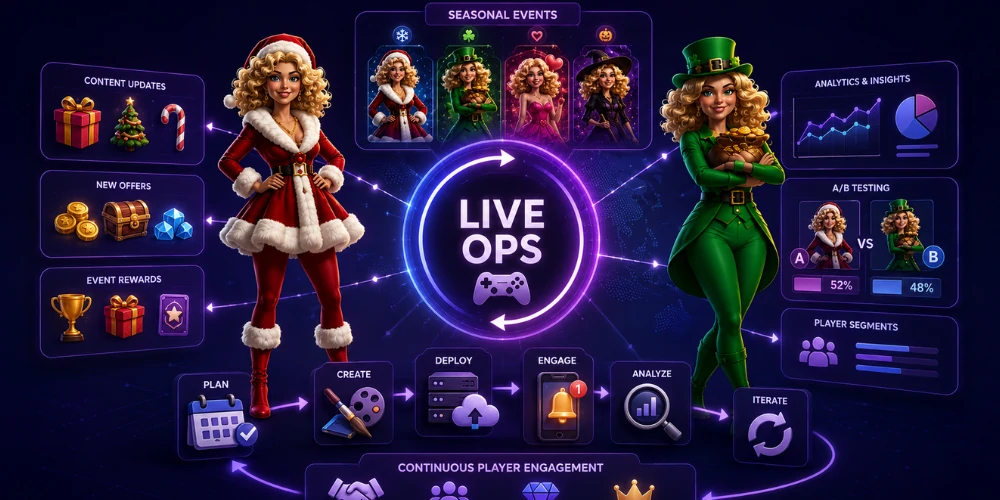
The growing role of live operations, analytics, and AI-driven tools further emphasizes the need for adaptable collaboration models. Static production setups are gradually being replaced by systems designed to evolve alongside the product.
Studios that view collaboration models as flexible frameworks rather than fixed solutions are better positioned to adapt to market changes.
A practical perspective from long-term production work
Working across different collaboration models over time highlights how rarely one approach fits every project. While building Whimsy Games and collaborating with teams at different stages of production, it became clear that the success of a development model depends less on its label and more on how well it matches the project’s real needs.
Some teams benefit from the clarity and accountability of a full-cycle setup, particularly when internal production resources are limited or when speed and predictability are critical. Others achieve better results through co-development, where shared ownership and tighter integration allow the product to evolve more naturally over time.
What consistently matters in both cases is not the model itself, but the structure around it: clear ownership, transparent communication, and a realistic understanding of how responsibilities are distributed between teams. When those elements are in place, both full-cycle development and co-development can support sustainable, long-term production rather than becoming a source of friction.
Choosing the Right Path Forward
Choosing between full-cycle development and co-development is not about identifying the superior model, but about understanding which approach best fits a project’s context, constraints, and ambitions.
In 2026, successful game development depends less on rigid structures and more on alignment, clarity of responsibility, and the ability to evolve. Teams that treat development models as strategic tools rather than default choices gain a significant advantage.
For studios evaluating their next project or reassessing an existing collaboration, taking the time to choose the right development model is an investment that pays off long after production begins.