
Plan Your 2026 Strategy: Game Development Services for Startups Explained
Struggling to launch your startup’s game by 2026 amid soaring costs and talent shortages? Most indie teams waste months on in-house development that drains budgets and delays releases. This article unpacks game development services tailored for startups, from full-cycle outsourcing to art partnerships, and offers a clear strategy for success. Over 30 global studios, such as Whimsy Games, prove that outsourcing can slash costs by 40-60%.
Introduction
The gaming landscape moves fast, and as we approach 2026, the pressure on startups to deliver high-quality content quickly is at an all-time high. For a new studio, attempting to build everything in-house is often a recipe for burnout and blown budgets. This is where strategic outsourcing comes in. It is no longer just about cutting costs; it is about accessing global talent pools to scale production instantly.
However, navigating the world of external development requires a clear head. You need to understand precisely what services are available and how the business model works. Many startups mistakenly view outsourcing studios as potential investors or equity partners. In reality, professional studios like Whimsy Games operate on a work-for-hire basis, ensuring you retain full control of your intellectual property (IP) while they handle the heavy lifting of execution.
What Are Game Development Services for Startups?
Game development services cover the entire spectrum of production, allowing startups to plug gaps in their expertise or capacity. Rather than hiring full-time staff for every role, you contract a specialised studio to deliver specific components or entire games.
“Game development outsourcing is when game development companies hire external teams or specialized studios to handle specific parts of their game creation.” – NIPS App (NIPS App)
It is vital to distinguish between a service provider and a publisher or investor. A service provider charges a fee for their time and expertise. They do not take equity in your company, nor do they fund your project in exchange for revenue share. This distinction is critical for your 2026 financial planning: you pay for guaranteed output and retain 100% of your future profits.
Full-Cycle Development
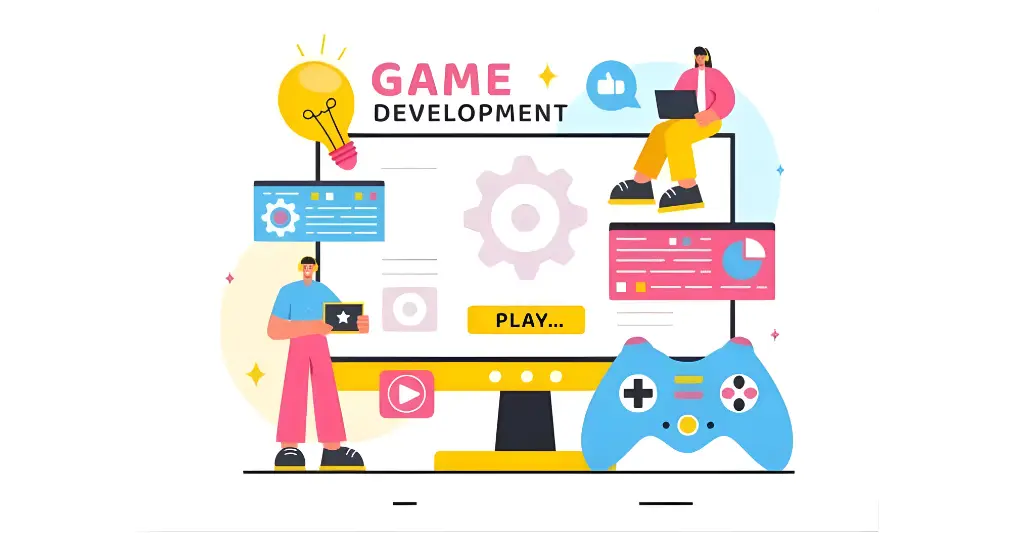
Full-cycle development is the “concept-to-launch” package. Here, you bring the core idea or design document, and the external studio handles everything else. This includes coding, art, sound design, quality assurance (QA), and project management.
For startups with a strong vision but limited technical teams, this is often the most efficient route. It allows your core founders to focus on marketing, community building, and business strategy while the external team builds the actual product. You own the code and assets at the end, but the studio executes the labour.
Co-Development Partnerships
Co-development (or co-dev) is often misunderstood. In the professional outsourcing world, co-development means technical collaboration, not financial partnership. You are hiring an external team to work alongside your internal developers, effectively extending your workbench.
Why Whimsy Games is not an investor:
Studios like Whimsy Games do not enter “co-partnership” deals where work is traded for future revenue share or equity. They are service experts, not venture capitalists. This model protects you:
- IP Protection: You pay for the work, so you own it completely.
- Clarity: There are no complex profit-sharing disputes later.
- Reliability: The studio is motivated by professional delivery standards, not speculative market performance.
| Aspect | Co-Development (Service) | Financial Partnership (Investing) |
| Collaboration Level | Long-term integration with your technical pipeline | Financial backing and business oversight |
| Creative Input | Partner teams shape creative decisions alongside you | Investors may demand changes to maximise ROI |
| Payment Model | Fee-based (Time & Materials or Fixed Price) | Equity or Revenue Share |
If you are still evaluating internal hiring versus external collaboration, read our detailed game development outsourcing vs in-house comparison to understand which model fits your studio best.
2D/3D Art and Animation Outsourcing
Art production is often the biggest bottleneck in modern game development. Outsourcing this function allows startups to generate massive amounts of content—characters, environments, UI, and animations—without maintaining a massive in-house art department.
This sector is evolving rapidly. Asset generation is 30–50% faster with AI tools, allowing studios to deliver higher volume at lower costs (NIPS App). However, human expertise is still required to maintain artistic consistency and style. By outsourcing art, you ensure your game looks competitive against triple-A titles without the overhead of a permanent art director and team.
Porting and Live-Ops Support
Launching your game is just the start. Porting services involve adapting your game for different platforms (e.g., taking a PC game to Nintendo Switch or mobile). Live-operations (Live-Ops) support involves creating new content, events, and updates to keep players engaged post-launch.
Key considerations for 2026 include:
- Cross-platform play: Cloud streaming lets players jump between mobile, PC, and console without missing a frame.
- Monetisation: Monetization is more sophisticated — live events, collaborations, and cross-platform progression.
- Scalability: Art pipelines are built for multiple resolutions from the start.
Why Outsource in 2026: Key Trends and Benefits
The market is shifting. In 2026, speed and flexibility will define successful startups. Building a massive internal team is risky and slow, outsourcing offers agility. You can scale up for production and scale down for maintenance, keeping your burn rate manageable.
The financial incentive is clear. The outsourcing market is growing because it works.
| Year | Estimated Market Value (USD Billion) | Growth Trend (%) |
| 2025 | 9.6 | 23% |
By leveraging external teams, you tap into specialised skills—like complex shader programming or rigging—that you might only need for two months. Hiring a full-time employee for a temporary need is inefficient; outsourcing solves this resource puzzle instantly.
How Game Development Outsourcing Works
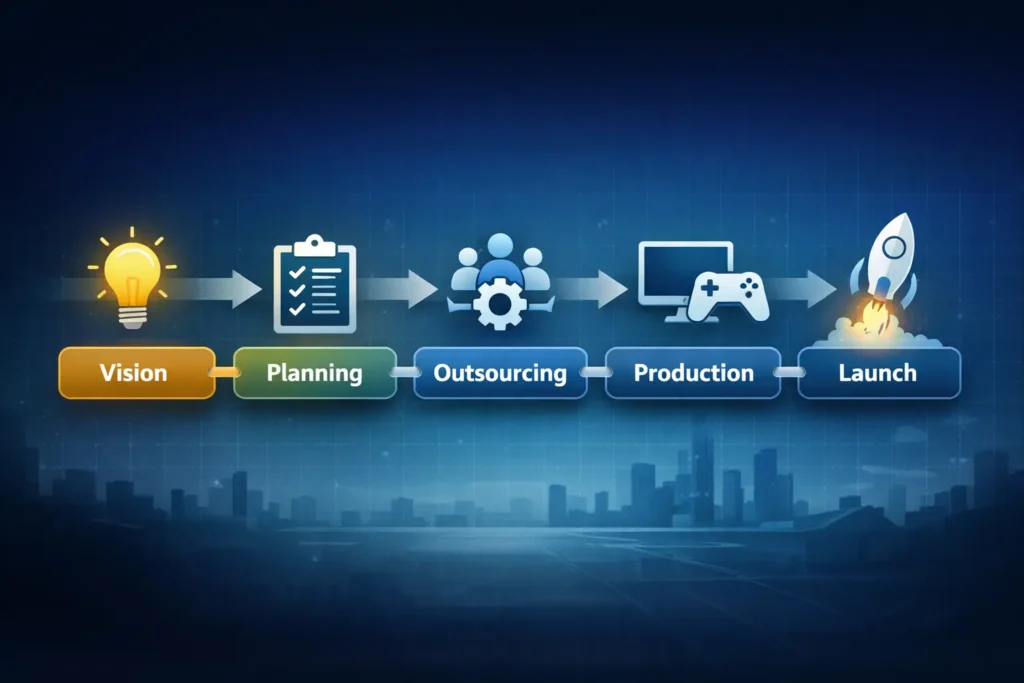
Successful outsourcing follows a structured pipeline. It is not as simple as handing over a document and waiting for a game to appear. It requires active management and a defined process.
A European mobile studio recently illustrated this impact: they reduced development time by 40%, launched 3 months early, and continued as long-term partners after the initial project success (NIPS App). This speed is achieved through rigorous planning and clear milestones.
Discovery and Scoping Phase
This is the foundation of the project. Before a single line of code is written, you and the studio must align on the Game Design Document (GDD).
During discovery, the studio assesses technical feasibility and art style. Crucially, this is where the budget is finalised. Since studios like Whimsy Games are not investors, they will provide a detailed quote based on the scope. This phase eliminates ambiguity, ensuring you know exactly what you are paying for and what deliverables to expect.
Prototyping and Iteration
Once the scope is set, the team moves to prototyping. The goal here is to “find the fun” quickly. The external team builds a Greybox (a playable version with placeholder art) to test mechanics.
This phase is iterative. You play the build, provide feedback, and the team adjusts. It is much cheaper to fix gameplay issues here than during full production. This is also where you test the working relationship—ensuring communication flows well between your internal stakeholders and the external project manager.
Production, Testing, and Launch
This is the longest phase, where assets are finalised, code is optimised, and the game comes together. Regular builds (often bi-weekly) keep you in the loop.
Technology is accelerating this stage significantly. Game-generating tools using GenAI can accelerate game development by 90%, particularly in coding routine scripts and generating level layouts (BCG Video Gaming Report). A professional studio will utilise these tools to save you money and time, handling the rigorous QA testing required to ensure a bug-free launch on all target platforms.
Best Practices for Successful Partnerships
The difference between a failed project and a hit often comes down to relationship management. Treat your outsourcing partner as an extension of your team, not a vending machine.
- Clear goals: Define success metrics early.
- Tight communication: Use tools like Slack or Discord for daily updates, not just email.
- Ethical partners: Choose studios with good labour practices; crunch culture leads to poor code.
- Shared tools: Ensure everyone uses the same version of Unity/Unreal and project management software.
Common Mistakes to Avoid
The most critical mistake startups make is misunderstanding the business model. Do not approach a service studio asking for free development in exchange for a percentage of future sales.
Service studios operate on tight margins to guarantee quality. They cannot risk their payroll on the speculative success of your game. If you ask for a “co-partnership” involving revenue share instead of payment, professional studios will likely decline. Other mistakes include vague feedback (“make it pop”), micromanaging every pixel, or failing to designate a single point of contact on your side, leading to conflicting instructions.
Building Your 2026 Outsourcing Strategy
To win in 2026, you need a strategy that balances internal core competencies with external muscle. The industry is massive, with revenue projected to reach $188.8 billion in 2025 (Newzoo via Gianty). To capture a slice of that, you need to release high-quality games faster.
Assessing Project Needs and Goals
Look at your internal team honestly. What are you missing? If you have great designers but no 3D artists, that is your outsourcing target.
Do not outsource your “secret sauce.” Keep the core creative vision and design leadership in-house. Outsource the execution—the modelling, the coding of specific modules, or the QA. This ensures you maintain the soul of the game while the studio handles the labour.
Budgeting and Timeline Planning
You must have secured funding before engaging a studio. Since they are not investors, they require payment milestones.
When budgeting, remember that outsourcing often pays for itself in speed. Development time can be reduced by 40% through outsourcing, meaning you reach the market (and revenue) nearly twice as fast (NIPS App). Factor in a 10-15% buffer for scope changes, as creative projects almost always evolve during development.
Selecting and Vetting Studios
Not all studios are equal. Look for a partner with a portfolio that matches your desired genre and art style.
- Check their track record: Have they shipped titles on your target platforms?
- Review their regions: Top outsourcing regions include India, Eastern Europe, and Southeast Asia, known for strong technical expertise, creative talent, and competitive pricing.
- Verify the model: Ensure they are a dedicated service provider who will sign over all IP rights to you upon payment.
Strategic Outlook for 2026
Planning your 2026 strategy requires acknowledging that you cannot do it all alone. Game development services offer the leverage startups need to compete with giants. By understanding that studios like Whimsy Games are expert service providers—not investors—you can build a professional, transparent relationship. You pay for expertise and speed, ensuring you retain full ownership of your game. With clear goals, a secured budget, and the right partner, you can turn your concept into a market-ready reality.