Comprehensive Guide to Gamification for Business: Benefits, Examples, and Development Strategies
The gamification market hit $19.4 billion in 2025 and is on track to reach $92.5 billion by 2030, a compound annual growth rate of 26%. That’s not a niche trend. That’s a structural shift in how businesses design products, retain users, and drive behaviour at scale.
We’ve seen this acceleration first-hand. More and more product teams are coming to us not with “we want a game” but with “we want our product to feel like one.” The ask has changed. The stakes have changed. And the companies building gamification right now, from Revolut to Adidas to Nubank, are pulling ahead of those who treat engagement as an afterthought.
What is Gamification?
Gamification is the use of game mechanics in non-game products to encourage users to complete desired actions. Businesses use points, rewards, challenges, levels, streaks and progression systems to improve engagement, retention, customer loyalty and learning outcomes.
Key insight: According to Mordor Intelligence, 45% of loyalty professionals ranked gamification as the number one trend for the next two to three years, placing it above automation and partner-based marketing. Gartner projects that 70% of global enterprise companies will integrate gamification by 2027. Separately, 2026 research shows gamified campaigns drive up to a 60% increase in customer engagement.
This guide covers what gamification actually means for a business product, which industries are deploying it most effectively, the mechanics that make it work, and what it takes to build it properly.
What Gamification Actually Means for a Business Product
Definition
Gamification in business is the application of proven game design principles to digital products in order to influence user behaviour, improve engagement and increase long-term retention.
Key Takeaways
- Gamification encourages users to perform desired actions through game mechanics.
- Successful gamification focuses on behaviour change rather than entertainment.
- Different industries require different mechanics and reward systems.
- Progression, feedback and analytics are more important than badges alone.
- Long-term optimisation is essential for sustained engagement.
Gamification is the application of game design mechanics to non-game contexts to drive specific user behaviour. Points, progress bars, streaks, leaderboards, challenges, rewards, and achievement systems all belong to this toolkit. But that definition only scratches the surface.
The real purpose is behavioural engineering. You’re designing systems that make a desired user action feel intrinsically rewarding. When someone opens your app daily because they don’t want to break a streak, that’s gamification working. When a customer spends more to reach the next loyalty tier, that’s gamification working. When a new employee completes onboarding modules because each one unlocks something, that’s gamification working.
What gamification is not
It’s worth being clear about what it isn’t, because a lot of poorly executed projects confuse the two:
- Not just badges and points. Slapping a point counter on a product without underlying reward logic creates short-term novelty, not retention.
- Not a substitute for a good product. Gamification amplifies engagement; it doesn’t manufacture it from nothing.
- Not a one-time feature. The best gamification systems are live, evolving, and data-driven. They require ongoing tuning.
The core mechanics that drive results
These are the building blocks we work with across every gamification project:
Mechanic | What it does | Where it works best |
Points & XP | Quantifies progress, creates investment | Loyalty programmes, onboarding |
Levels & tiers | Creates aspiration and status | Finance apps, retail loyalty |
Streaks | Builds habitual return | EdTech, health, trading platforms |
Leaderboards | Drives social competition | B2B SaaS, sales tools, fitness |
Challenges & missions | Structures desired behaviour | Retail, onboarding flows |
Rewards & unlocks | Reinforces completion | E-commerce, subscription products |
The mechanics you choose depend entirely on your user psychology and business goal. There’s no universal stack. That’s why every project we take on starts with a game mechanics audit before a single line of code is written.
How to Choose the Right Gamification Mechanics
Choosing the right mechanics depends on the behaviour you want users to adopt. Different business goals require different combinations of game design elements.
Business Goal | Recommended Mechanics | Expected Outcome | Why It Works |
Increase daily active users | Streaks, daily rewards | Higher daily engagement | Builds habit formation |
Improve onboarding | Progress bars, milestones | Higher completion rates | Reduces friction and motivates progress |
Increase repeat purchases | Tiered loyalty, challenges | More repeat transactions | Encourages progression and status |
Boost learning completion | XP, badges, levels | Better course completion | Reinforces achievement and motivation |
Improve retention | Missions, personalised rewards | Higher long-term retention | Keeps users engaged over time |
There is no universal combination of mechanics that works for every product. The right mix depends on your users, business objectives and product lifecycle. That’s why every gamification project at Whimsy Games starts with a discovery phase before mechanics are selected.
Gamification by Industry: Where It’s Delivering Real Results
Fintech, retail, and EdTech are the three highest-adoption verticals for gamification in 2026 – and each one deploys it differently. The industry, user base, and business model all shape which mechanics work and why. Here’s what that looks like in practice.
Fintech: turning financial behaviour into a habit
Fintech has arguably become the most aggressive adopter of gamification mechanics. Revolut uses streaks and spending insights to keep users engaged daily. Robinhood built its early growth on confetti animations and achievement-style onboarding. Nubank turned credit card management into a progression system with tiers, rewards, and social sharing.
The underlying goal in all these cases is the same: make financial activity feel rewarding rather than stressful. When checking your balance or completing a savings goal triggers a positive feedback loop, users return more often and churn less.
What gamification solves in fintech:
- Low daily active usage for non-transactional users
- High churn in the first 30 days after sign-up
- Difficulty differentiating on product features alone
- Low engagement with financial education and advisory features
The real risk for fintech teams: building gamification that rewards the wrong behaviour. Incentivising trades for the sake of activity, for instance, creates regulatory exposure and user distrust. The mechanics need to align with genuine user outcomes, not just engagement metrics.
Retail and e-commerce: loyalty systems that actually drive spend
Traditional loyalty programmes, the punch-card model, have a well-documented problem: most users collect points and never redeem them. Gamification fixes this by making the journey to redemption feel worthwhile in itself.
Adidas has built tiered membership systems where unlocking each level requires specific actions: completing workouts, making purchases, attending events. The tier itself becomes the reward, not just the discount at the end.
What gamification solves in retail:
- Flat loyalty programme participation rates
- Low average order value among non-premium segments
- Difficulty driving repeat purchase without discounting
- Weak emotional connection between brand and casual customers
Key takeaway: Gamified loyalty programmes consistently outperform traditional points schemes on repeat purchase frequency. The mechanism is simple: when customers can see their progress toward the next tier, they change their behaviour to reach it.
EdTech and corporate training: making learning stick
This is the vertical we know most closely at Whimsy Games. We’ve built gamified educational products that transform what would otherwise be passive content consumption into active, progress-driven learning.
The core problem in EdTech is completion. Course completion rates for self-directed e-learning sit below 15% on most platforms. Gamification addresses this directly by creating micro-rewards for progress, social accountability through leaderboards, and narrative structures that make the next module feel like the next level.
What gamification solves in EdTech and training:
- Low course completion rates
- Poor knowledge retention from passive video content
- Lack of motivation for voluntary corporate training
- Difficulty demonstrating ROI on L&D investment to stakeholders
Example: Gamifying Language Learning
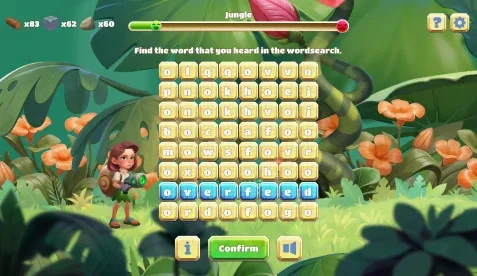
One example is educational word game , a gamified educational platform designed to help children learn language through interactive challenges and progression-based gameplay.
Challenge
Educational organisations struggled with low student engagement, poor course completion and declining long-term retention.
Our solution
We transformed traditional learning into an interactive experience using:
- progression systems
- collectible rewards
- achievement mechanics
- daily practice incentives
- engaging gameplay loops
Business outcomes
- Higher student retention
- Improved course completion
- Increased motivation to learn
- Stronger long-term engagement
Need an educational game?
Engage learners better.
Get in touch.Contact us
How to Build a Gamification System That Works
A gamification system that works requires five things: a defined target behaviour, mapped user psychology, a feedback loop architecture, a progression design, and instrumented measurement. Most projects fail because they skip one or more of these. Teams bolt on a points system at the end of development, skip user psychology research, or treat it as a marketing initiative rather than a product architecture decision. Here’s how we approach it differently.
Step 1: Define the behaviour you want to change
Before selecting a single mechanic, you need to answer one question: what specific user action do you want to increase, decrease, or reshape? “Better engagement” is not an answer. “Increase the percentage of users who complete onboarding within 48 hours” is.
This precision matters because every mechanic you choose should map directly to that target behaviour. Streaks work for daily return. Challenges work for task completion. Leaderboards work for competitive contexts. If you can’t draw a straight line from mechanic to behaviour, cut the mechanic.
Step 2: Map your user psychology
Different users respond to different motivations. A useful framework here is the distinction between intrinsic motivators (mastery, autonomy, purpose) and extrinsic motivators (rewards, status, competition). The strongest gamification systems activate both.
We ask every client to identify their primary user archetype before we design the system:
- Achievers respond to levels, badges, and completion tracking
- Explorers respond to discovery mechanics and hidden content unlocks
- Socialisers respond to leaderboards, co-op challenges, and sharing
- Competitors respond to rankings, time-limited events, and PvP mechanics
Designing for the wrong archetype is the most common reason gamification falls flat.
Step 3: Build the feedback loop architecture
The core engine of any gamification system is the feedback loop: action, feedback, reward, next action. This loop needs to be fast enough to feel responsive, meaningful enough to feel worth repeating, and variable enough to avoid predictability.
The variable reward principle is critical here. Fixed rewards (complete task, get 10 points) create habit. Variable rewards (complete task, get 8-15 points with a chance of a bonus) create compulsion. The distinction matters both ethically and practically. For most business products, habit is the right target.
Step 4: Design for progression, not just participation
A gamification system without a progression architecture is a flat experience. Users need to feel that they’re moving somewhere. This means:
- A clear starting state that feels achievable
- Visible milestones at regular intervals
- Escalating challenge that matches growing user skill or commitment
- An aspirational ceiling that feels distant but reachable
This is where genuine game design expertise makes the difference. Progression architecture is the same discipline that keeps players in games for hundreds of hours. Applied to a business product, it keeps users engaged for months rather than days.
Step 5: Instrument, measure, and iterate
Gamification is not a launch-and-leave feature. The metrics you track should map directly to the behaviour you defined in step one. If you built a streak system to drive daily active usage, your primary metric is day-7 and day-30 retention, not total points earned.
We build analytics instrumentation into every gamification system we deliver. Without it, you’re flying blind on whether the mechanics are actually working or just creating the illusion of engagement.
What “Gamification as a Service” Actually Looks Like
Gamification as a service (GaaS) means an external specialist partner designs, builds, and iterates on your gamification system – so you don’t need to hire an in-house game design team. When clients come to us at Whimsy Games for gamification as a service, they’re typically looking for one of three things:
- A standalone gamification layer built on top of an existing product (most common)
- A greenfield gamified product designed from the ground up with game mechanics at its core
- A gamification audit and redesign of an existing system that isn’t performing
What distinguishes a genuine gamification partner from a feature shop is the combination of game design expertise and software engineering depth. The mechanics need to be psychologically sound. The implementation needs to be technically robust. And the whole system needs to integrate cleanly with your existing product stack.
What we bring to a gamification engagement
We’re a game development studio. That means our gamification work is grounded in the same disciplines we use to build games people play for hundreds of hours: reward psychology, progression design, feedback loop architecture, and live operations.
We’ve worked on projects spanning fintech apps, educational platforms, corporate training tools, and retail loyalty systems. The brief is always different. The underlying craft is the same.
Across our gamification projects, we consistently see one pattern: businesses achieve the best results when gamification is introduced as part of the product strategy rather than as a standalone feature. Successful systems combine behavioural design, analytics and continuous optimisation instead of relying solely on rewards.
Our typical engagement covers:
- Discovery and user psychology research
- Mechanic selection and progression architecture design
- Full-cycle development (front-end, back-end, analytics)
- Integration with your existing product or platform
- Post-launch support and iteration
If you’re evaluating whether gamification is the right investment for your product, the honest answer is: it depends on what behaviour you’re trying to change and whether your product has the user volume to generate meaningful data. We tell every client this upfront. Gamification is not a silver bullet, but for the right product and the right problem, it’s one of the highest-ROI investments a product team can make.
The market data backs this up. A 26% CAGR through 2030 doesn’t happen because of hype. It happens because the companies deploying gamification are seeing it work.
Why Whimsy Games?
At Whimsy Games, we apply the same principles used to build engaging games to business software.
Why companies choose us:
- 100+ delivered projects across multiple industries
- 8+ years of game development experience
- Full-cycle development from discovery to post-launch support
- Expertise in game design, progression systems and behavioural mechanics
- Experience building gamification solutions for EdTech, FinTech, retail and enterprise platforms
- Dedicated designers, developers, artists and product specialists working as one team
Our focus isn’t simply adding points and badges. We design systems that create measurable business outcomes through long-term user engagement.
Is Your Product Ready for Gamification?
Not every product is a good candidate, and we’d rather tell you that now than after a wasted scoping exercise. Here are the signals that suggest gamification will work for your product:
Strong signals:
- You have a clear, repeatable user action you want to increase (daily logins, feature adoption, purchase frequency)
- Your users have a reason to return to the product beyond a single transaction
- You have enough user volume to run meaningful A/B tests on mechanic variants
- Your product has a natural progression or learning curve
Weak signals:
- Your core product experience is broken or confusing (fix that first)
- Your user base is entirely transactional with no repeat engagement model
- You’re looking for a quick fix to declining retention without addressing the underlying cause
If you’re seeing strong signals, the next step is a discovery conversation. We’ll look at your product, your user data, and your business objective, and tell you honestly whether gamification is the right lever and what it would take to build it well.
Get in touch with our team to start that conversation.

Written by
Daria HoloskokovaMarketing Team Lead
I am an energetic Marketing Executive currently making waves at Whimsy Games, where my path is filled with vibrant growth and innovative strides. In this dynamic world of game development, I lead pivotal marketing strategies that have notably elevated our brand's visibility and successfully attracted essential Marketing Qualified Leads. My involvement is crucial in executing precise digital campaigns and developing compelling content, while also building strong partnerships with vendors and effectively working with various teams within our company.