LiveOps Outsourcing in 2026: What It Costs, What It Covers, and When You Need It
Downloads are flat. UA costs are up. And the studios still growing revenue have one thing in common: they are running LiveOps properly.
According to AppMagic’s 2025 LiveOps Report, the average number of live events per game climbed from 73 at the start of 2025 to 89 per month by year-end, even as IAP revenue growth across the tracked dataset slowed to just 0.7%. The studios winning in that environment are not launching more games. They are extracting more value from the players they already have.
That creates a real operational problem. Running LiveOps at competitive density requires a dedicated team: engineers for backend and remote config, artists for event content, data analysts for A/B testing, and a producer coordinating the calendar. For a studio without that infrastructure, building it in-house is expensive, slow, and carries real talent risk.
Outsourcing LiveOps solves this — but the market is opaque. Pricing varies by four or five variables. Scope definitions differ between vendors. And the question of when outsourcing actually makes sense versus keeping it in-house rarely gets a straight answer.
At Whimsy Games, we have been building and running LiveOps programmes for studios across mobile, PC, and console for over eight years. We work with studios at every stage of this decision: from soft-launch titles testing their first event calendar to mid-core games running weekly content drops across multiple platforms. One of those studios was the team behind Royal Slots: they came to us with a finished game, no LiveOps infrastructure, and a launch date. Within three months they had 100,000 active users and an 85% thirty-day retention rate. We will walk through exactly how that worked later in this guide.
This is our honest answer to the outsourcing question. We cover what LiveOps outsourcing actually includes, what it costs at each tier in 2026, which engagement models work for different studio sizes, and the specific signals that tell you it is time to bring in an external partner.
Here is what we will walk through:
- What falls under the LiveOps outsourcing umbrella
- 2026 pricing: hourly rates, monthly retainers, and per-tier breakdowns
- In-house vs outsourced: the honest cost comparison
- When outsourcing is the right move (and when it is not)
- What to look for in a LiveOps partner
What LiveOps Outsourcing Actually Covers
LiveOps is not a single deliverable. It is an ongoing operational function, and what you outsource depends on which parts of that function your internal team cannot handle at the required pace.
When studios come to us with a LiveOps brief, we typically see four categories of work on the table:
Content Production
This is the most visible layer: seasonal events, limited-time offers, new characters, cosmetic drops, holiday-themed environments, and battle pass tiers. Content production requires artists, animators, and sometimes narrative designers working on a continuous calendar. For a game running at the level of the most active titles tracked by AppMagic (89 events per month by end of 2025), this is a significant volume operation.
Backend and Systems Engineering
LiveOps runs on infrastructure: remote configuration systems, A/B testing frameworks, event scheduling tools, push notification pipelines, and live server management. An outsourced partner handles the engineering that makes real-time content delivery possible without requiring a full app store release for every update.
Analytics and Optimisation
Data is what separates a LiveOps programme that grows revenue from one that just keeps the lights on. This includes tracking event performance, player segmentation, spend analysis, funnel diagnostics, and iterating on monetisation mechanics based on real behaviour. Sensor Tower’s 2025 Live Ops report found that the top-grossing titles run multi-layered event systems combining recurring, feature, and large-scale events simultaneously, and that this architecture is what separates games generating over $100 million in annual IAP from the rest of the market.
Community Management and Player Communication
Patch notes, in-game messaging, social media updates tied to live events, and player feedback loops. Not every studio outsources this layer, but for free-to-play titles with active communities, it is part of the LiveOps function.
Post-Launch Technical Support
Bug fixes, performance monitoring during live events, server load management, and platform-specific patches. This is particularly relevant during high-traffic seasonal events when a server issue can directly cost revenue.
From our experience at Whimsy Games: most studios outsource content production and engineering, share analytics with the partner, and keep community management in-house. The right split depends on where your team is strong and how much volume you need to sustain. There is no universal answer, and any partner who tells you otherwise before understanding your game is not worth talking to.
LiveOps Outsourcing Costs in 2026: What the Market Actually Charges
This is the question most guides avoid giving a direct answer to. Here is what the market looks like in 2026, based on published rate data and project benchmarks across the industry. The figures below are industry estimates drawn from outsourcing cost guides and practitioner benchmarks; actual costs vary by region, studio size, platform count, and project complexity.
Hourly Rates by Discipline
LiveOps draws on multiple disciplines, and each has its own rate band. According to GameDevOutsourcing.com’s 2026 cost guide, current market rates are:
| Discipline | Entry-Level | Mid-Range | Senior/Expert |
| 2D Art / Content | $25–40/hr | $40–75/hr | $75–150/hr |
| Animation | $35–55/hr | $55–100/hr | $100–180/hr |
| Backend Engineering | $35–60/hr | $60–120/hr | $120–250/hr |
| QA / Testing | $15–25/hr | $25–45/hr | $45–80/hr |
| Analytics / Data | $40–70/hr | $70–130/hr | $130–200/hr |
Add 10–20% for project management overhead on top of these rates — a figure consistently cited across outsourcing cost guides, including GameDevOutsourcing.com’s 2026 analysis.
Monthly Retainer Tiers
Most LiveOps outsourcing is priced as a monthly retainer rather than hourly, because the work is ongoing and the team composition is relatively stable. The three tiers we see most commonly:
Minimum Viable LiveOps: $10,000–$20,000/month
- Monthly seasonal events
- Basic content updates
- Essential analytics and monitoring
- Small team: 2–3 specialists
- Best fit: indie titles, soft-launch phase, games testing LiveOps viability
Mid-Tier LiveOps: $20,000–$60,000/month
- Weekly events and challenges
- Regular content drops (characters, items, maps)
- Advanced analytics and A/B testing
- Dedicated team: 4–8 specialists
- Community management included
- Best fit: mid-core titles with an established player base
Full-Scale LiveOps: $60,000–$150,000+/month
- Daily content rotation
- Major seasonal updates and live event production
- Large team: 8–15 specialists
- 24/7 monitoring and support
- Advanced personalisation and segmentation
- Best fit: competitive multiplayer titles, games-as-a-service, AAA co-development
A practical benchmark from the market: ongoing LiveOps for a mid-complexity free-to-play mobile title typically runs $15,000–$60,000 per month, depending on content velocity and team size. This range is consistent with the cost data published in GameDevOutsourcing.com’s 2026 analysis, which remains one of the most detailed publicly available breakdowns of outsourced game development costs by discipline.
What Drives the Price Up
Not all LiveOps engagements at the same tier cost the same. These factors push budgets toward the higher end:
- Cross-platform delivery (iOS, Android, PC, console simultaneously)
- High event frequency (weekly or daily cadence vs monthly)
- Custom tooling requirements (if your game uses a proprietary backend)
- Real-time monitoring with SLA guarantees (24/7 support costs significantly more than business-hours coverage)
- Localisation (running events across multiple languages and regions)
We ask every client to be explicit about these variables before we scope a LiveOps engagement at Whimsy Games. The difference between a $15,000/month and a $45,000/month programme often comes down to event frequency and platform count, not team quality.
A typical mistake we see: studios underestimate platform count when budgeting. A game on iOS and Android looks like one product. Add a PC client and a console port, and the LiveOps complexity doubles. Get this number right before you request a quote from any partner.
In-House vs Outsourced LiveOps: The Honest Cost Comparison
The instinct to keep LiveOps in-house is understandable. You want control over your game’s live content and player experience. But the cost comparison is less favourable to in-house than most studios expect when they run the numbers.
What an In-House LiveOps Team Actually Costs
A lean but functional in-house LiveOps team for a mid-core mobile title typically needs:
| Role | Annual Salary (UK market) | Annual Salary (US market) |
| LiveOps Producer / Manager | £55,000–£72,000 | $90,000–$120,000 |
| Backend Engineer (LiveOps systems) | £50,000–£79,000 | $100,000–$140,000 |
| 2D Artist (event content) | £35,000–£55,000 | $55,000–$85,000 |
| Data Analyst | £40,000–£65,000 | $70,000–$100,000 |
| QA Specialist | £28,000–£45,000 | $45,000–$65,000 |
UK salary ranges are based on Technet Immersive’s 2025 gaming salary benchmarks. US ranges reflect market data from the 2026 State of Developer Salaries report. That is a base payroll of roughly £208,000–£316,000 (UK) or $360,000–$510,000 (US) per year, before benefits, equipment, software licences, and recruitment costs. On top of base salary, benefits and employer contributions typically add a further 20–30%, which is consistent with standard employment cost modelling across both markets.
The outsourced equivalent runs $240,000–$720,000 per year (the $20,000–$60,000/month mid-tier range, consistent with published outsourcing cost benchmarks for 2026), with no recruitment overhead, no benefits liability, and the ability to scale up or down based on your content calendar.
The Hidden Costs of In-House
Beyond salary, in-house LiveOps carries costs that rarely appear in the initial business case:
- Ramp-up time: Recruiting a senior specialist alone takes an average of 42 days, according to published outsourcing cost guides for 2026, with onboarding adding several months before full productivity. An outsourced team with existing LiveOps infrastructure can begin active production significantly faster.
- Talent risk: LiveOps specialists are in demand. Losing a backend engineer mid-event cycle is a serious operational risk.
- Tooling and infrastructure: Remote config systems, analytics platforms, A/B testing tools. These are included in an outsourced engagement. In-house, they are additional budget items.
- Idle capacity: Your LiveOps team needs to be staffed for peak event periods. During quieter months, you are paying full salaries for reduced output.
Here is what we tell clients at Whimsy Games who are on the fence: outsourcing does not mean losing control of your game. It means buying operational capacity without the fixed cost structure. You set the strategy, approve the content calendar, and own the player data. We handle the execution. The studios that struggle with outsourcing are usually the ones who confuse delegation with abdication.
When In-House Makes More Sense
Outsourcing is not always the right answer. In-house LiveOps makes sense when:
- Your game has reached a scale where LiveOps is a permanent, core business function and the team can be kept fully utilised across a long roadmap
- You need sub-24-hour iteration cycles that require deep game engine access
- Your LiveOps strategy is a proprietary competitive advantage you do not want to share with any external partner
- You have already built the team and the question is whether to expand it, not whether to start it
When You Actually Need LiveOps Outsourcing
The situations that push studios toward outsourcing LiveOps follow recognisable patterns. Here are the most common ones, with honest guidance on each.
You Have Just Launched and Need to Sustain Momentum
The first 90 days post-launch are critical for free-to-play titles. Player retention drops sharply without new content. The problem is that most studios have just spent their development budget shipping the game and do not have a LiveOps team standing by.
Outsourcing at this stage lets you run a minimum viable LiveOps programme ($10,000–$20,000/month) while you assess whether the game has the retention metrics to justify a larger investment. It is a low-risk way to test LiveOps before committing to headcount.
Your Core Team Is Fully Allocated to the Next Title
This is the most common scenario we see. The studio has a live game generating revenue, but the team has moved on to the next project. No one is watching the metrics. Events are being skipped. Player retention is drifting.
An outsourced LiveOps partner keeps the live game running and earning while your internal team focuses on what comes next. At Whimsy Games, this is one of the most common engagements we take on: a live title generating revenue, a core team that has moved on, and a gap that needs filling without a six-month hiring cycle. You can see how we structure this through our LiveOps game development service.
We often see this: by the time a studio realises their live game needs help, retention has already dropped two or three percentage points. That is recoverable, but it takes longer to fix than it would have taken to prevent. The studios that outsource early keep the momentum. The ones that wait are playing catch-up.
You Need to Scale Event Frequency Without Scaling Headcount
According to Sensor Tower’s analysis of top-grossing mobile titles, in 2025 there were 135 games generating over $100 million in IAP revenue, collectively reaching $50.8 billion. What they share is multi-layered event architecture: simultaneous recurring, feature, and large-scale events running in parallel. Sustaining that cadence with a small in-house team requires dedicated LiveOps infrastructure that most studios do not have at launch.
Outsourcing gives you access to a full production team without the hiring cycle, with the ability to scale content velocity in line with your roadmap rather than your headcount.
You Are Entering a New Market or Platform
Launching a game in a new region, or porting to a new platform, requires LiveOps content that is culturally and technically appropriate. A partner with cross-platform experience (iOS, Android, PC, console) and regional knowledge handles this without requiring your core team to develop new expertise from scratch.
You Need Specialised Skills You Do Not Have In-House
LiveOps analytics, in particular, requires skills that most game development teams do not have. Understanding cohort behaviour, building segmentation models, running statistically valid A/B tests, and interpreting the results accurately is a specialist function. Outsourcing the analytics layer of your LiveOps programme is often the highest-ROI decision a studio can make.
The pattern worth watching for: studios almost always wait too long. They run minimal LiveOps with an overstretched team, retention quietly drops, and by the time they bring in an external partner, they are trying to recover a game that has already lost its window. LiveOps is much easier to sustain than it is to restart. The right time to outsource is before the problem shows up in the data.
Engagement Models: How LiveOps Outsourcing Is Structured
Not all outsourced LiveOps looks the same. The engagement model you choose affects cost, control, and how quickly you can scale. We see three primary structures in the market.
Full LiveOps Management
The partner owns the entire LiveOps function: content calendar, event production, backend management, analytics, and reporting. You approve the strategy and review results, but the day-to-day operation is handled externally.
This model works well for studios with a live game and no internal LiveOps capacity. It is the fastest path to a running programme, but it requires a high level of trust in the partner and clear contractual agreements around content approval workflows.
Typical cost: mid-tier to full-scale range ($20,000–$150,000+/month depending on game complexity)
Co-Development / Staff Augmentation
Your internal team leads the LiveOps strategy, and the outsourced partner provides specific capabilities you lack: a 2D artist for seasonal content, a backend engineer for remote config, or an analyst for A/B testing. The partner integrates with your team rather than replacing it.
This is the model most studios with some internal LiveOps capacity prefer. It is more flexible, easier to manage, and allows you to scale specific disciplines up or down based on your content calendar.
Typical cost: project-based or hourly, often $10,000–$40,000/month depending on the disciplines engaged
Project-Based LiveOps
A defined scope: a single seasonal event, a battle pass system build, a new feature launch. The partner delivers a specific output with a fixed timeline and budget, then the engagement ends or transitions to an ongoing retainer.
This model is common for studios testing an outsourcing relationship before committing to a long-term engagement. It carries higher per-unit cost than a retainer but lower risk.
Typical cost: $5,000–$50,000 per project depending on scope
| Model | Best For | Control Level | Cost Structure |
| Full LiveOps Management | Studios with no internal LiveOps team | Partner-led, studio approves | Monthly retainer |
| Co-Development / Augmentation | Studios with partial internal capacity | Shared | Hourly or retainer |
| Project-Based | Testing the relationship, one-off events | Studio-led | Fixed-price per project |
What to Look for in a LiveOps Outsourcing Partner
Choosing a LiveOps partner is different from choosing a development studio for a greenfield project. The criteria that matter most are around operational reliability and integration, not just portfolio quality.
Cross-Platform Experience
Your game may be on mobile today, but live service games increasingly span platforms. A partner who has only worked on mobile LiveOps will struggle if you need to synchronise events across iOS, Android, and a PC client. We ask every prospective partner about the platforms they have shipped live updates on, not just the platforms they have developed for.
Engine Familiarity
LiveOps implementation in Unity and Unreal Engine is meaningfully different. Remote configuration, event hooks, and analytics integration all depend on how the game is built. A partner unfamiliar with your engine stack will spend the first weeks of an engagement just getting up to speed. Look for studios with demonstrated experience in the specific engine your game runs on. At Whimsy Games, our team works across both Unity and Unreal Engine, which matters operationally, not just on paper, when you are shipping live updates across platforms. We have seen engagements fall apart in the first month simply because the partner had to learn the client’s engine from scratch while the content calendar was already running.
A Defined QA and Rollout Process
LiveOps updates that ship with bugs during a live event are not just a technical problem. They are a revenue problem. A partner should be able to describe their QA process, their phased rollout approach, and how they handle a critical bug during a live event. If they cannot answer these questions with specifics, that is a red flag.
Data Access and Reporting Transparency
You own your player data. A good partner makes that data accessible, not opaque. Before signing any LiveOps engagement, clarify who owns the analytics infrastructure, how data is shared, and what reporting you will receive. A good partner provides post-event analysis after every LiveOps cycle: what worked, what did not, and what is being adjusted for the next one. Clarify this expectation before signing.
Relevant Portfolio, Not Just a Showcase
A portfolio full of impressive launch trailers does not tell you much about LiveOps capability. Ask specifically for examples of ongoing LiveOps work: event cadences they have maintained, retention improvements they have driven, and how long their LiveOps engagements typically run. Long-term relationships are a better signal than one-off projects.
A common failure mode we see: a studio hires a partner based on portfolio aesthetics, then discovers the partner has no backend LiveOps infrastructure. Suddenly they are managing two vendors — one for content, one for engineering — and the coordination overhead eats into the time and budget they were trying to save. A partner who covers the full LiveOps stack is worth paying a premium for. We ask every client to test this before signing: describe a critical bug during a live event. How does the partner respond? If they hesitate, that is your answer.
A typical failure mode we see at Whimsy Games: a studio hires a partner based on portfolio aesthetics, then discovers the partner has no backend LiveOps infrastructure. Suddenly they are managing two vendors — one for content, one for engineering — and the coordination overhead eats the time and budget they were trying to save. A partner who covers the full LiveOps stack is worth paying a premium for.
For more context on how to evaluate outsourcing relationships across the full development lifecycle, our guide to selecting a game development outsourcing partner covers the evaluation criteria in depth.
The Market Context: Why LiveOps Outsourcing Is Growing in 2026
The structural shift driving demand for LiveOps outsourcing is worth understanding, because it explains why this is not a passing trend.
According to AppMagic’s full-year LiveOps data, mobile game downloads grew 4.1% in 2025, but IAP revenue growth across AppMagic’s tracked dataset slowed to just 0.7%. The studios growing in that environment are not acquiring more users at scale. They are monetising the audience they already have more effectively.
The response from the market’s top performers has been consistent: invest in LiveOps depth, not user acquisition breadth. Sensor Tower’s 2025 Live Ops report documented that 135 mobile games generated over $100 million in IAP revenue in 2025, collectively reaching $50.8 billion. The common factor was not genre or IP. It was multi-layered LiveOps execution: simultaneous recurring, feature, and large-scale events running in parallel.
What this means for mid-size studios: the event density required to stay competitive has risen sharply. By the end of 2025, the average across titles in AppMagic’s dataset had reached 89 events per month, up from 73 at the start of the year, according to AppMagic’s LiveOps Report. Genre benchmarks vary: casual titles average around 92 events per month, hybridcasual around 64, and casino titles as many as 150. Sustaining even the lower end of that range without a dedicated team or an outsourced partner is not a realistic proposition for most studios.
The hybridcasual segment illustrates the monetisation dynamic clearly. Despite downloads declining 4% year-over-year in 2025, hybridcasual IAP revenue grew 75% to $788 million, driven primarily by puzzle content, according to AppMagic’s full-year data. Revenue growing while the audience shrinks is a direct signal that LiveOps execution is extracting more value per player, not that the market is expanding.
For studios evaluating their options, the question is not whether to run LiveOps. It is whether to build the capacity to run it or to buy it. For most studios without an existing LiveOps team, outsourcing is the faster path to a running programme and carries less fixed-cost risk than committing to headcount before you know what the game needs.
To understand how LiveOps fits into a broader post-launch strategy, our Live Ops and Game Maintenance guide covers the operational fundamentals in detail.
Summary: What to Take Away From This Guide
LiveOps outsourcing in 2026 is a mature, well-defined market. The pricing is not a mystery once you understand what drives it. The decision framework is straightforward once you are honest about your internal capacity.
Here is the short version:
- What it covers: content production, backend engineering, analytics, community management, and technical support. Most studios outsource the first two and share the third.
- What it costs: $10,000–$20,000/month for minimum viable LiveOps, $20,000–$60,000/month for mid-tier, $60,000–$150,000+/month for full-scale. Hourly rates for individual disciplines range from $25/hr (entry-level 2D art) to $250/hr (senior backend engineering).
- When to outsource: post-launch to sustain momentum, when your core team has moved to the next title, when you need to scale event frequency without scaling headcount, or when you lack specific skills (particularly analytics).
- What to look for: cross-platform experience, engine familiarity, a defined QA and rollout process, transparent data ownership, and a portfolio of ongoing LiveOps work rather than one-off projects.
The logic is straightforward. IAP revenue is concentrating in studios that run LiveOps at high density — 135 games generated over $100 million each in 2025, collectively accounting for $50.8 billion in IAP, according to Sensor Tower. Building that capacity in-house takes time and carries fixed cost. For studios without an existing team, outsourcing is the faster path to a running programme, with the flexibility to scale as the game matures.
If you are at the point of making this decision, we are happy to give you a straight answer on what makes sense for your game specifically — not a sales pitch, just an honest assessment.
Our LiveOps game development service covers everything from minimum viable event programmes to full-scale live operations across Unity and Unreal, on mobile, PC, and console. Get in touch and we will start with your game, your team, and what you actually need to achieve.
LiveOps Outsourcing in Practice: Royal Slots
Numbers on a page only tell you so much. Here is what LiveOps outsourcing actually looked like on a project we delivered — from the brief to the outcomes.
The Brief
The client came to us with a mobile casual game — Royal Slots — built around slot machine mechanics with a premium casino aesthetic. The game was ready to launch, but the client had no internal LiveOps infrastructure. They needed dynamic in-game events and regular content updates to keep players engaged past the initial install, without disrupting the core gameplay loop.
The challenges were specific:
- Tight timeline. The game needed a working LiveOps system from day one of launch, not weeks later.
- Mobile optimisation. Rich visual content had to run smoothly across a wide range of devices.
- LiveOps complexity. Dynamic events and updates had to integrate cleanly with existing gameplay mechanics.
- Data-driven iteration. The client wanted analytics and A/B testing built into the LiveOps process, not bolted on afterwards.
What We Delivered
The Whimsy Games team — 18 people across art, engineering, design, QA, and production — handled the full scope:
- A streamlined LiveOps system for timely content updates and feature rollouts
- A/B testing and analytics integration to optimise mechanics and engagement strategies
- Regular events and updates to keep gameplay fresh across the player lifecycle
- Community feedback integration to inform ongoing improvements
The engagement covered content production, backend systems, QA, and live monitoring — the full stack, not just the art layer.
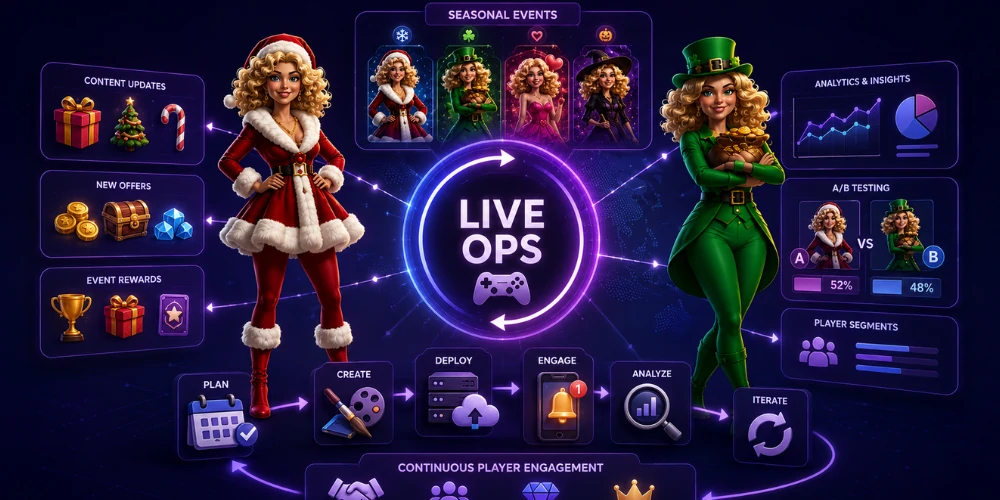
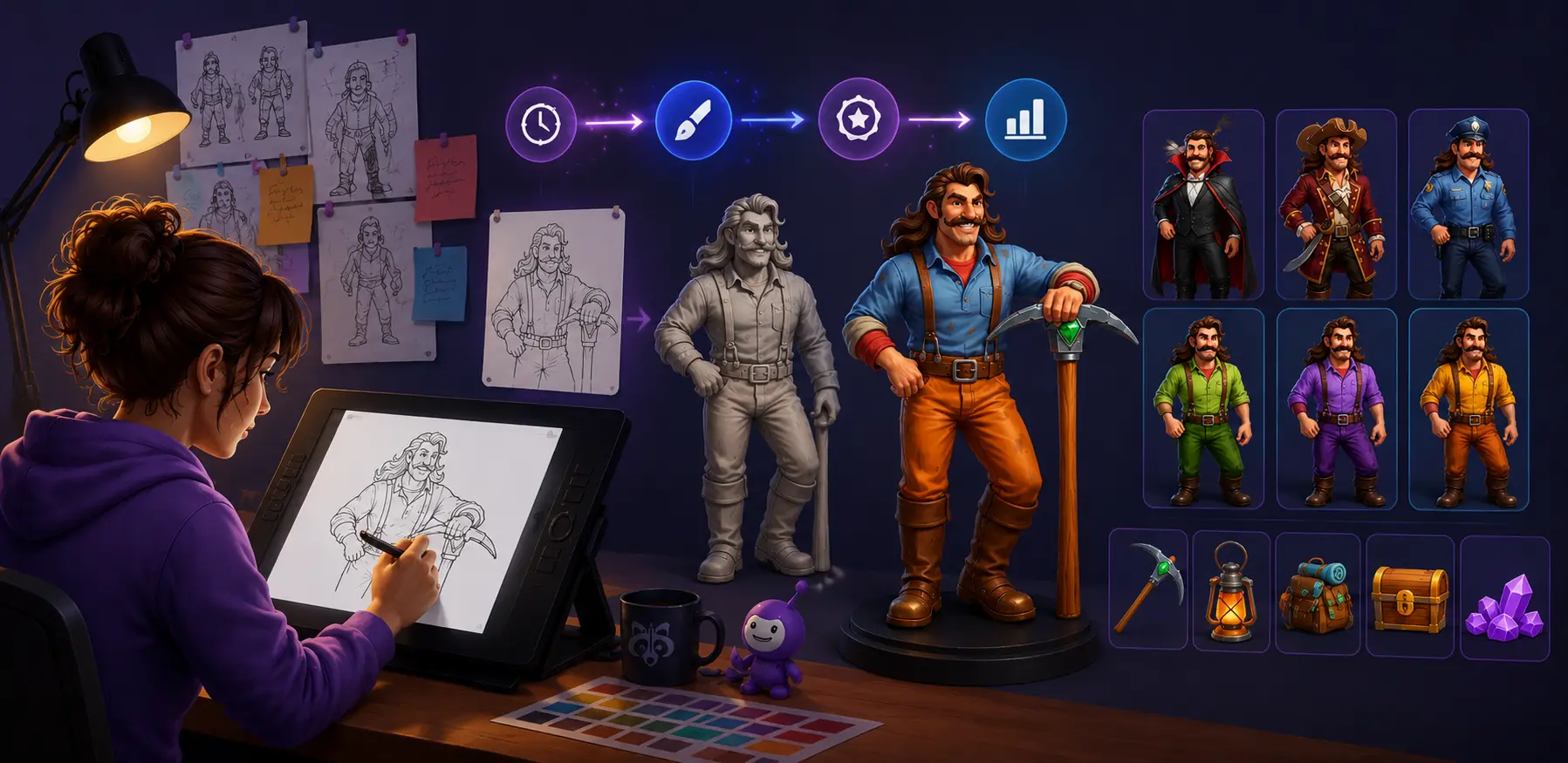
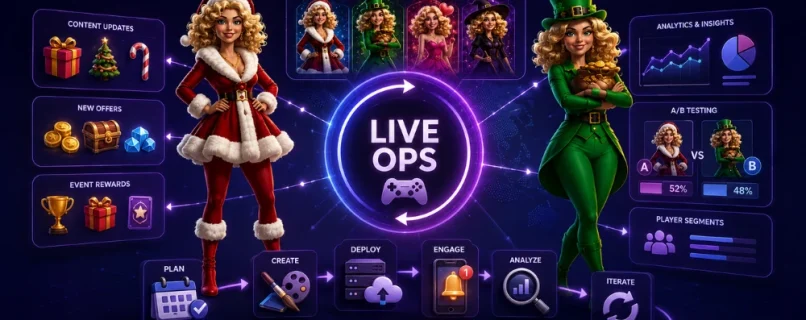
One example of how content production worked in practice: rather than building entirely new assets for each seasonal event, we designed character variants that could be reskinned against the existing rig. A Santa suit for December, a leprechaun look for St. Patrick’s Day. Low production cost, fast turnaround, and each variant doubled as an A/B testing opportunity across player segments.
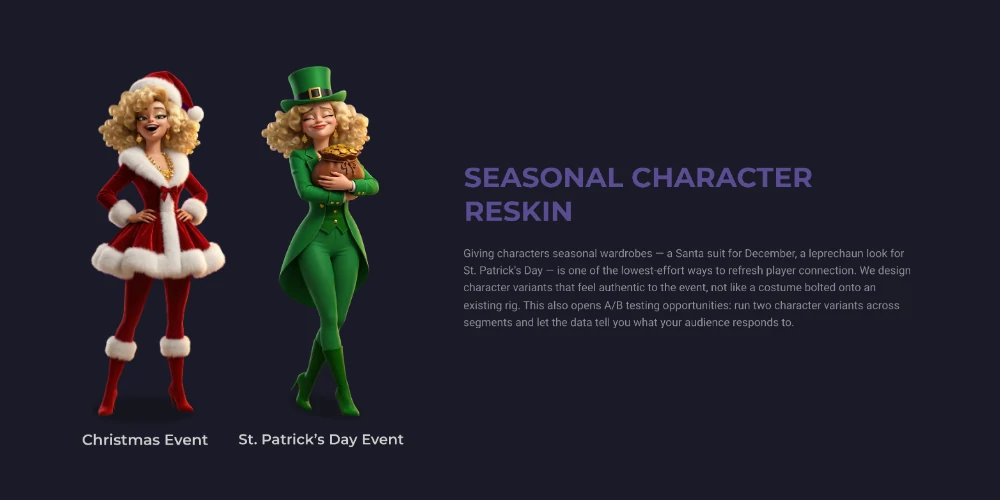
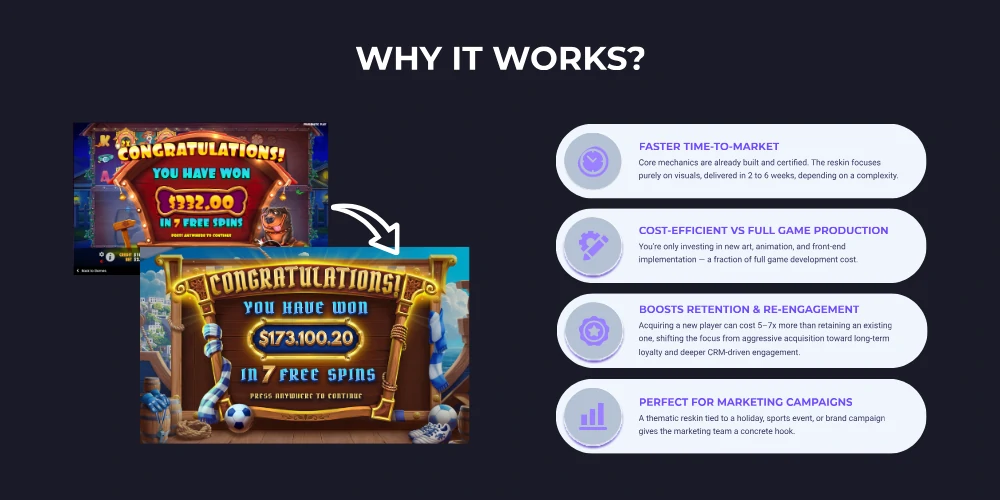
This approach — reskin against an existing rig rather than rebuild from scratch — is one of the most cost-efficient moves in LiveOps content production. Core mechanics are already built. The reskin focuses purely on visuals, typically delivered in two to six weeks depending on complexity. It keeps the content calendar moving without blowing the art budget.
The Outcomes
85% retention rate after 30 days. 94% positive reviews citing visuals and immersive gameplay.
The average D30 retention for casual mobile titles sits at around 7%. Royal Slots held 85%. That kind of result does not happen by accident — it happens when LiveOps is part of the launch plan, not an afterthought added after the first retention drop.
Read the full breakdown: Royal Slots — Creative Vision, Technical Power.