Introduction to AI’s transformative impact on the gaming industry and game development.
Overview of AI-powered tools enhancing storytelling, character creation and gameplay.
Examination of AI’s role in creating adaptive and personalised game narratives.
Exploration of AI’s influence on character creation, enabling human-like behaviour and interactions.
Discussion of AI-generated dialogue that offers branching narratives and replayability.
Analysis of AI-driven dynamic storylines and game worlds tailored to player actions.
Conclusion on AI as a game-changer shaping the future of immersive gaming experiences.
Updated in April 2026
AI’s role in game storytelling has moved well beyond the experimental. In 2026, studios are no longer asking whether to use AI in narrative development – they’re deciding how much creative control to hand it. Tools built on large language models are now generating branching dialogue at scale, adapting storylines in real time to individual player behaviour, and helping smaller studios achieve narrative depth previously achievable only with large writing teams.
The shift has been rapid. Since this article was first published, the landscape has changed significantly: Inworld AI, Replica Studios, and integrated LLM pipelines inside Unreal Engine 5 have moved from proof-of-concept to production use. Meanwhile, the industry is grappling with harder questions – around authorship, creative quality, and the risk of homogenised storytelling. This article explores where AI in script adaptation stands today, what it genuinely delivers, and where the limitations still bite.
Understanding AI in Game Development
AI, powered by machine learning and natural language processing, is at the forefront of game development. It enables game developers to create unique experiences, adapt game mechanics, and enhance player engagement. AI in game development goes beyond visual effects; it reshapes player choices, game testing, content generation, and virtual reality experiences. Many game studios are now integrating AI to push the boundaries of interactive storytelling and create next-level gaming experiences. Unreal Engine, a leader in Unreal game development, utilises AI to deliver groundbreaking narrative depth and immersive gameplay. The gaming industry has embraced AI as a crucial tool, utilising its potential to revolutionise game design, narrative depth, and immersive gameplay.
AI plays a significant role in video game storylines, transforming the way narratives are crafted and experienced by players. With AI, game developers can create immersive, adaptive narratives that allow players to shape the story through their decisions and actions. AI’s delicate balance between creativity and skill level enables game developers to design narratives that offer unique experiences for individual players.
AI-driven game narratives not only provide a personalised gaming experience but also enhance player engagement and emotional depth. By analysing player behaviour, AI can dynamically adjust the story, creating challenges that match the player’s skill level and keeping them immersed in the game world. This adaptive approach to storytelling ensures that every player has a memorable and engaging experience, regardless of their gaming expertise.
AI and Its Impact on Brand Voice in Gaming Industry
AI has a profound impact on brand voice in the gaming industry, revolutionising how games are developed, marketed, and experienced by players. By utilising AI, game developers can create content that resonates with players on a deeper level, enhancing player engagement and entertainment experiences.
AI’s influence in the gaming industry goes beyond content creation. It extends to player behaviour analysis, social media engagement, and personalised recommendations. By leveraging AI, game developers can tailor their games to individual player preferences, providing a more immersive and satisfying gaming experience. AI-powered algorithms analyse player data, allowing developers to understand player behaviour, adjust game mechanics, and create content that resonates with their target audience.
The use of AI in brand voice development also enables game developers to explore new ideas and experiment with different genres. AI algorithms can generate unique dialogue options, character interactions, and game mechanics, resulting in games that feel fresh, innovative, and ahead of their time. This use of AI not only enhances player engagement but also keeps the gaming industry at the forefront of entertainment innovation.
AI in Crafting Engaging Content
AI has transformed the way content is created in the gaming industry, leading to the development of more engaging and immersive experiences for players. The use of AI in content creation allows game developers to generate unique game worlds, characters, and narratives. By leveraging machine learning and procedural generation techniques, AI can create content that adapts to player actions, preferences, and skill level, ensuring a personalised and captivating gaming experience.
How AI is Revolutionising Character Creation in Video Games
AI’s impact on character creation in video games has revolutionised the way players interact with virtual worlds. With AI, game developers can create characters that exhibit human-like behaviour, emotional depth, and unique personalities. AI algorithms analyse player choices, preferences, and actions, allowing characters to adapt and evolve over time, providing immersive and dynamic gaming experiences.
The use of AI in character creation also opens up new possibilities for player choices and interactions. AI-generated dialogue options can offer players a range of responses, leading to branching narratives and different outcomes based on individual decisions. This level of player agency enhances player engagement and replayability, as they explore different paths and experience new storylines with each playthrough.
AI-Generated Dialogue in Video Games: An Emerging Trend
AI-generated dialogue in video games is an emerging trend that is reshaping character development, player decisions, and immersive storytelling. With advancements in natural language processing, AI can generate dialogue options that are tailored to the player’s choices, creating more immersive and engaging character interactions.
AI-generated dialogue offers a range of benefits for game developers and players alike:
Increased character depth: AI-generated dialogue enables characters to have more nuanced, human-like conversations, fostering emotional connections between players and virtual characters.
Improved player agency: AI-generated dialogue offers players a wide variety of choices, leading to branching narratives and different outcomes based on their decisions.
Dynamic character development: AI can analyse player behaviour and adapt character dialogue accordingly, creating characters that evolve and respond to player actions in a believable way.
Enhanced role-playing experiences: AI-generated dialogue can provide players with realistic, immersive experiences where their choices and dialogue options shape the game’s outcome.
Greater replayability: AI-generated dialogue options offer different paths and outcomes, encouraging players to play the game multiple times to explore all the possibilities.
The Evolution of AI in Video Games
The evolution of AI in video games has been monumental, transforming game mechanics, adaptive difficulty, and player experiences. In the early years of gaming, AI was limited to simple enemy behaviour and rule-based systems. However, with advancements in AI technology, game developers now have access to sophisticated machine learning algorithms, deep learning, and procedural generation techniques, allowing for more realistic and immersive game worlds.
AI’s Role in Creating Dynamic Storylines
AI plays a crucial role in creating dynamic storylines in video games, empowering game developers to design narratives that adapt and respond to player actions. By utilising procedural generation techniques, AI can generate unique game worlds, quests, and challenges based on player choices, creating an immersive and personalised gaming experience.
Thanks to AI, game worlds can dynamically change in response to player actions, providing a sense of agency and impact. This level of dynamic storytelling enhances player engagement, as their decisions shape the narrative and influence the game world. AI’s role in creating dynamic storylines opens up new possibilities for players to experience unique, personalised narratives, ensuring that every playthrough feels fresh and rewarding.
The Evolution of Dialogue in Video Games
The gaming world has witnessed a transformative shift in dialogue evolution, thanks to the influence of artificial intelligence. AI’s impact on dialogue evolution is not only reshaping game narratives but also revolutionizing player engagement and game world immersion. In essence, AI is offering new, innovative ideas for game design, character development, and game mechanics. Its emergence in dialogue evolution is transforming player decisions, dialogue options, and virtual characters, promising immersive, adaptive player experiences. This paradigm shift is redefining game narratives by offering deep learning, natural language processing, and emotional depth in dialogue options, ultimately enhancing the overall gaming experience.
Implementing AI in Video Games
Implementing AI in video games has become an essential part of developing games with AI, offering game developers powerful creative tools that enhance gameplay, storytelling, and immersive experiences. AI is no longer just a tool for visual effects; it is now integrated into every aspect of game development, from procedural content generation to character behaviour analysis.
The Pros and Cons of AI in Game Storytelling
AI-assisted narrative development offers real advantages, but it comes with trade-offs that any studio should understand before committing.
Advantages
Scale without proportional cost. AI can generate thousands of contextually appropriate NPC lines, ambient dialogue, and branching responses that would take a team of writers months to produce manually.
True adaptive narratives. LLM-powered systems can dynamically adjust story beats based on player history, choices, and play style, creating genuinely personalised experiences rather than the illusion of choice.
Faster iteration. Writers can use AI to quickly produce first-draft variations, freeing them to focus on refining tone, character voice, and emotional beats rather than volume.
Accessibility for smaller studios. Indie and mid-size teams can now achieve narrative complexity that was previously out of reach without large writing budgets.
Drawbacks
Risk of generic storytelling. AI trained on existing content can produce dialogue and plot structures that feel familiar rather than original. Without strong creative direction, outputs tend to average out.
Loss of authorial voice. Distinctive writing – the kind that defines franchises like The Witcher or Disco Elysium – is difficult to replicate with AI. Over-reliance can flatten a game’s identity.
Ethical and legal uncertainty. Questions around training data, IP ownership, and fair compensation for writers remain unresolved, and the regulatory environment is evolving rapidly.
Quality control overhead. AI-generated content requires careful human review. Errors in tone, factual inconsistencies, or off-brand dialogue can slip through at scale if review processes are not robust.
Player trust. Some players actively push back against AI-generated content, particularly in narrative-heavy genres where craftsmanship is part of the appeal.
Unsure Where to Begin??
Reach out to Us Today to Enhance Your Game’s
Narrative and Captivate Your Audience Like Never Before!
In conclusion, AI has transformed the gaming industry in remarkable ways. From creating dynamic storylines to generating engaging content and revolutionizing character creation, AI has proven to be a game-changer. While there are challenges and ethical considerations to address, the potential of AI in gaming is undeniable. It enhances player experiences, breathes life into game characters, and redefines the way we play and enjoy games. As we look towards the future, it is exciting to see how AI will continue to shape the gaming landscape. If you’re interested in exploring the possibilities of AI in game development, get in touch with us. Let’s embark on an adventure together and push the boundaries of gaming with AI.
Get in touch
To make your gaming ideas in reality
Table of contents
Frequently Asked Questions
How is AI being used in game script writing?
AI is used in game script writing for: generating first-draft dialogue variations that writers then refine, creating contextually appropriate NPC responses at scale (replacing thousands of hand-written lines), adapting existing scripts to different character personalities or tones, assisting with localisation by generating culturally appropriate translations, and identifying narrative inconsistencies through automated story analysis.
Can AI write better game stories than human writers?
Current AI cannot match skilled human writers for emotional resonance, thematic depth, or original creative vision. AI excels at generating volume (thousands of NPC lines), maintaining consistency across large dialogue systems, and producing competent first drafts quickly. The most effective approach uses AI to handle high-volume, lower-stakes writing while human writers focus on main story beats, key character moments, and creative direction.
What is procedural narrative generation in games?
Procedural narrative generation uses AI to create story content dynamically based on player actions and game state. Rather than pre-writing all story outcomes, the system generates contextually appropriate narrative responses to player choices. Dwarf Fortress is a landmark example, generating emergent stories from simulated world events. Modern LLMs make procedural narrative far more sophisticated, enabling natural language storytelling that adapts to individual player histories.
I am the Chief Product Officer at Whimsy Games, where my extensive background in engineering, management, and game analytics shapes my approach to product strategy and development. My experience, gained at leading game development studios, is a cornerstone in driving our projects from conception to market. My responsibilities extend to ensuring that our games not only meet our high creative and technical standards but also align with market demands, driving the success of Whimsy Games in a highly competitive industry.
Latest Posts
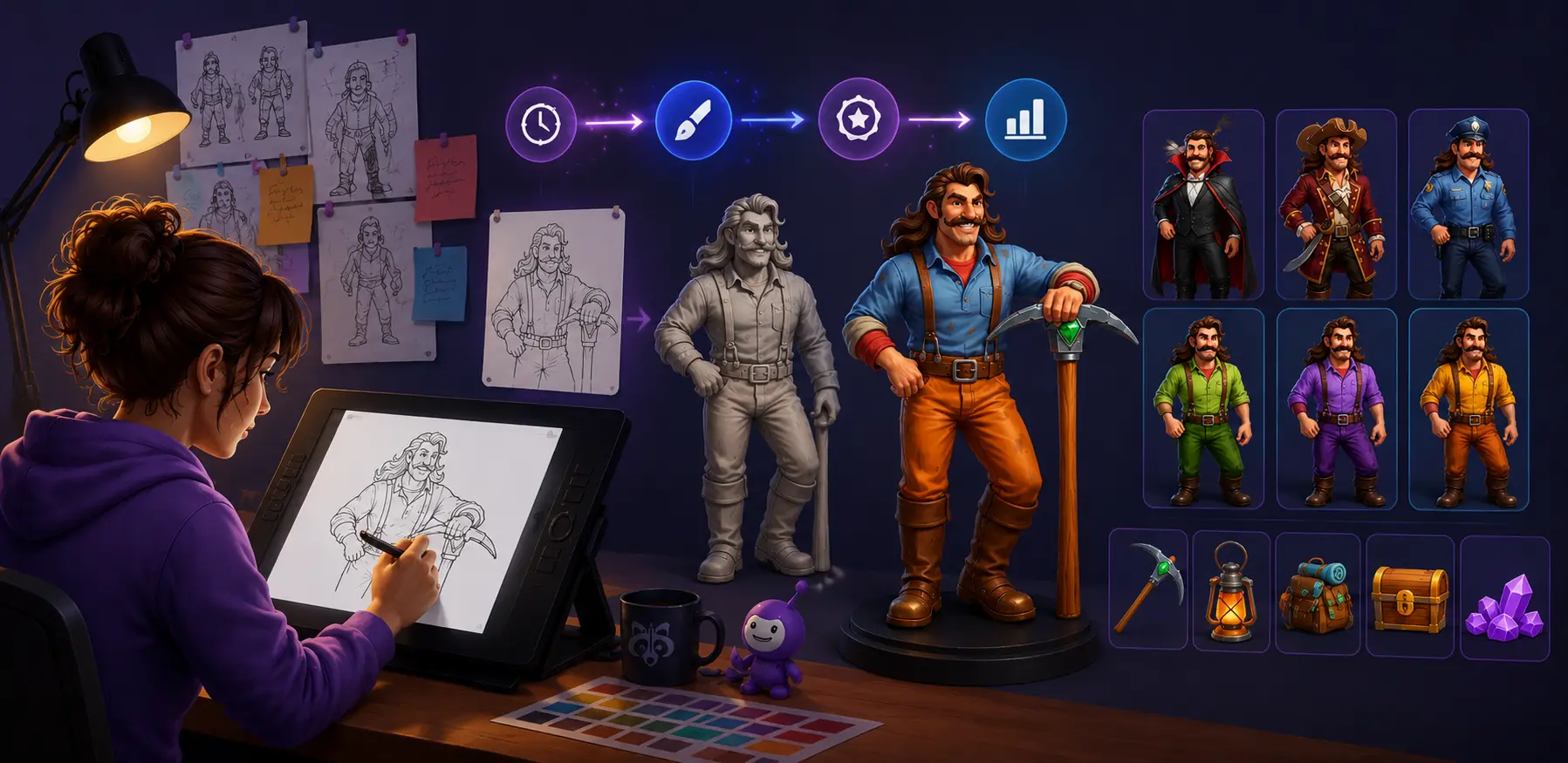
We at Whimsy Games can create any character, background, or object you need to make your mobile game stand out from others.