
KEY POINTS OF THE ARTICLE
- Introduction to the enduring popularity of 2D games despite the rise of 3D games.
- Overview of the creative freedom and simplicity offered by 2D art styles.
- Focus on market growth in 2D fighter games, projected to reach a CAGR of 9% by 2028.
- Insights into 2D game art, focusing on flat characters and objects.
- Highlights of technological advancements that have enhanced 2D art design.
- Comparison between 2D and 3D art in terms of goals, controls, and movement.
- Advantages of 2D game art include cost-effectiveness and quick production.
- Drawbacks of 2D game art include limited movement and versatility.
- Advantages of 3D art include high-quality graphics and immersive environments.
- Key differences between 2D and 3D game art styles in visual complexity and gameplay.
- Steps for creating 2D game art, starting with defining your project’s style.
Despite the dominance of 3D titles, two-dimensional games have never lost their appeal. For players, they offer straightforward controls and immediately readable gameplay. For studios, they remain one of the most cost-effective and creatively flexible formats in the industry.
The global 2D game market is growing steadily in 2026, driven by the indie boom, the rise of cozy games, and the explosion of mobile-first titles across iOS and Android. From pixel art roguelikes to anime-influenced RPGs, 2D continues to produce some of the most commercially successful and critically acclaimed games of the year.
We at Whimsy Games have over seven years of experience designing diverse two-dimensional work. This guide covers the major 2D art styles, how they differ from 3D, and how to choose the right one for your project.
2D Art Styles for Mobile and Cross-Platform Games in 2026
- Why mobile constraints still shape 2D art decisions (screen size, performance, file size)
- Which styles translate best across iOS, Android, and PC – pixel art, flat design, and vector
- Production cost comparison: which styles are fastest to adapt for multiple platforms
- Brief note on aspect ratio and UI considerations per style
How AI Tools Are Changing 2D Game Art Production
- Where studios are using AI today: concept generation, palette exploration, asset variation
- What AI still cannot replace: art direction, brand consistency, character personality
- How Whimsy Games approaches AI-assisted workflows without losing creative quality
- A short note on client expectations and what to ask your art studio about their AI policy
How to Choose a 2D Art Style for Your Game Genre and Goals
- A decision framework: genre, audience, budget, and timeline
- Style-to-genre mapping table:
| Art Style | Best-Fit Genre | Key Advantage |
|---|---|---|
| Pixel Art | Platformer, RPG | Nostalgia, low asset cost |
| Flat Design | Casual, Puzzle | Fast to produce, scalable |
| Cel Shading | Action, Fighter | Strong visual identity |
| Doodle Art | Hyper-casual | Low cost, fast iteration |
| Monochromatic | Narrative, Indie | Mood-driven, distinctive |
WHAT IS 2D GAME ART?
Two-dimensional art is usually associated with flat characters and objects. Unlike 3D art, which includes depth, height, and width, 2D game art is always just height and width. However, this doesn’t mean 2D art styles look incomplete or dull. It’s easy to add character and uniqueness to your two-dimensional styles with light, saturation, colors, and creativity.
Collaborating with a professional 2d art company can help bring all creative visions to life, ensuring your game stands out in the market.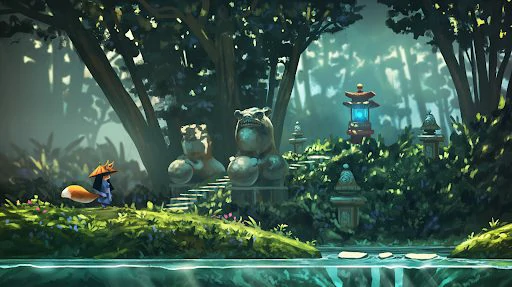
2D art design was quite limited at first. Computers and game development software weren’t capable of producing high-quality, well-detailed creatives. However, today, you can see that it is no longer valid. With advanced tools, apps, and hardware, 2D art design has evolved dramatically. You can now create 2D art styles of any complexity, level of detail, and imagination. Improvements in visual composition enable artists to create intricate, dynamic graphic elements that weren’t possible before. Using creative visuals, modern 2D art design is now more detailed and artistically rich, pushing the limits of what’s achievable in game development.
WHAT IS THE DIFFERENCE BETWEEN 2D AND 3D ART? ADVANTAGES AND DISADVANTAGES OF 2D GAME ART
The most apparent difference between 2D and 3D art styles is the sense of volume and depth. However, it’s way more than just that.
Let’s look at what sets 2D and 3D art apart.
Goals — in 2D games, the goals and mechanics are just as simple as the art. 3D allows developers to widen their horizons and create more complex gameplay
Controls — 3D games offer more complicated controls and allow players to do more, even if the game itself is pretty easy to play
Movement — since 2D games are linear, and they are usually about forward movement with limited ability to explore the surroundings; however, it’s more distinct and always has a start and an endpoint
Environment — with less focus on landscapes, 2D can’t offer a rich visual experience; the core aspect is gameplay
These are the main factors affected by your choice of game art styles. It can also influence the level of visual attractiveness and engagement with the game. Although 3D projects may be more complex and offer more varied movement and controls, focusing too much on visuals can distract from gameplay.
Plus, 3D titles may seem too difficult to control or understand. People can get confused and not realize where to go and what to do in the game. Too much freedom isn’t always helpful, so people often stick to 2D games.
If we talk about the scope of genres for both styles, 2D art works best for casual game development, time-killers, and games for kids. They’re easy to play and comprehend, so you can quickly get to the whole point of playing. As for 3D art, it’s best used in hardcore games, motion-based games like simulators, and those with detailed, complex environments.
When we talk about game genres, 2D art is awesome for casual games, time-killers, and kids’ games. They’re super easy to play and understand, so you can get right into the fun. 2D game studios are like development hubs where all the cool ideas come to life. They’re like creative workshops that mix the simple style of 2D art with cool new designs. Plus, they work as interactive labs, letting developers quickly create games that look great and are super engaging.
The advantages of 2D game art include:
- Cost-effectiveness
- Fast production
- Ease of updates
However, there are some drawbacks too. Here are some of them:
- Lack of navigation and movement variety
- Low versatility
- Lack of realism
If we speak about 3D game art, some of its key advantages are:
- High-quality graphics
- A multitude of tasks and missions
- Easier movement creation
The main drawbacks of 3D game art include:
- High production costs
- Complicated pipeline development and maintenance
- The higher complexity of production and updates
Overall, here’s a comparison table of the main differences between 2D and 3D game art styles:
2D Art Styles
Greater focus on the gameplay and mechanics
Cheap production and updates
Simplistic and more cartoonish look
Linear games with start and end points
Simple production process
3D Art Styles
Greater focus on the visual compounds and special effects
High production costs
More realistic look
Freedom of navigation and movement
Tech-savvy
When creating immersive visuals, 3D art services allow developers to deliver more dynamic and engaging environments. The choice between 2D and 3D styles depends on the project’s goals, budget, and desired user experience.
THE PROCESS OF CREATING 2D ART FOR THE GAME
Let’s look through some of the key steps in creating 2D video game art styles.
Step 1. Define the Style of Your Project
Choose the style you want for your future project. There are various options: from cartoonish or monochrome to pixelated and flat-art concepts. Or, maybe you want to mix the styles somehow and add a personal touch. While thinking about it, always keep in mind what genre you want to work on, your target audience and their preferences, and the game’s story.
Step 2. Work on Game Assets
Once you’ve chosen the genre and the style, you’ll need game development assets. They are among the main things you’ll need for creating 2D art styles. They help set up the surrounding world in your game. It’s every detail you add to the project: buildings, objects, characters, status or health bars, etc. No need to explain why you won’t be able to produce a game without them.
Step 3. Start Developing the Concept Art
If you already have some basic ideas on what your project should look like, you may start working on concept art. It’s fast and simple — this is a perfect thing to do to get an approximate vision of what your game would look like. It’s not the final one that you’ll be implementing to your game. Still, it gives you the core you can work with.
Step 4. Bring Your Ideas to Life
After that, the design process begins.
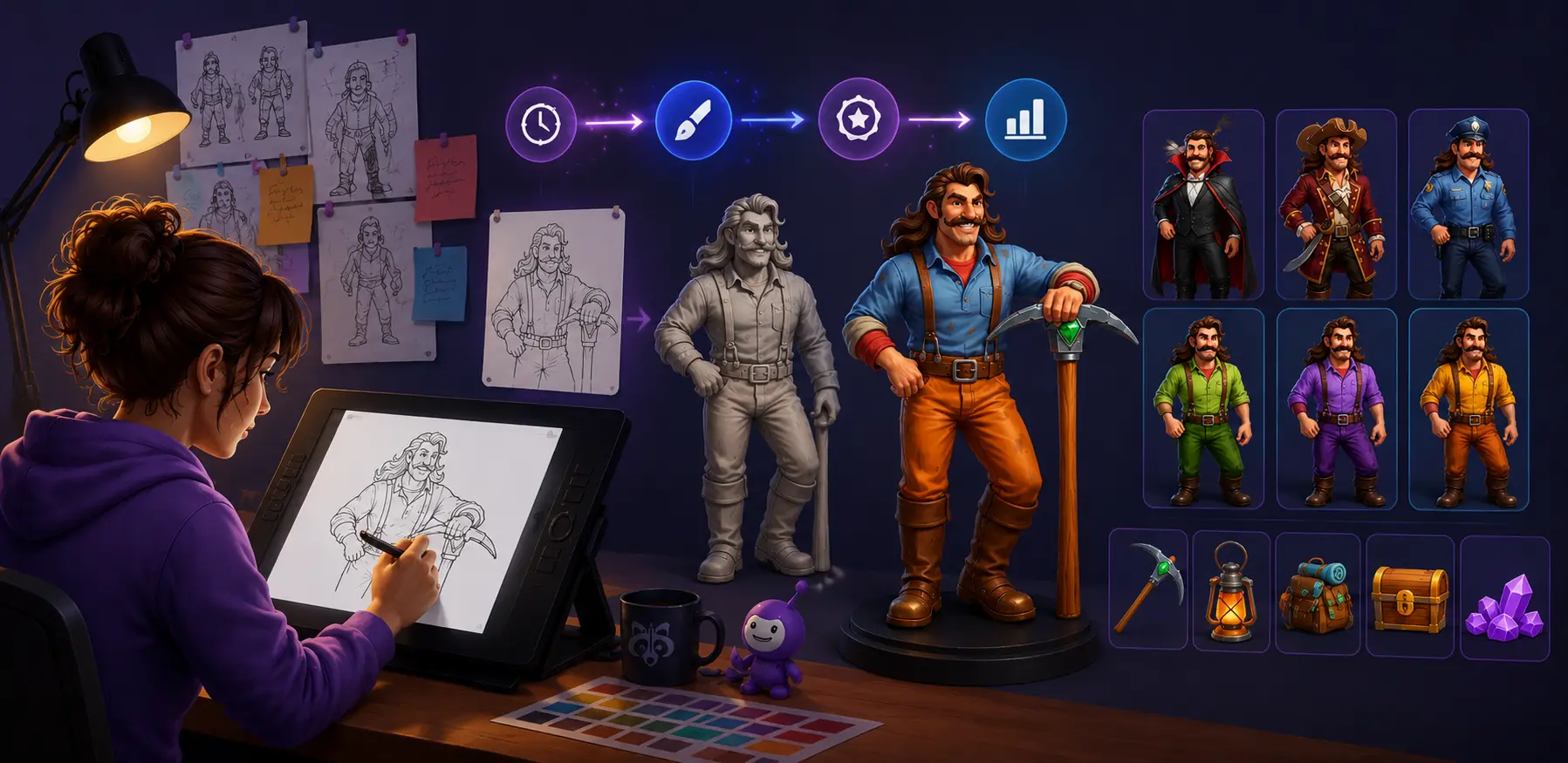
Work on character design. Artists take the plain-text description from the scriptwriters and turn it into a real person, animal, robot, or other creature. Character design is also about drawing clothes and everything that makes up their look.
With characters comes the environment design. You already know the style you want to apply, so you must consider the details of the world you’re about to create, including its specific features, history, and locations for each level.
Finally, think of the icons and items. Your game can look perfect and be a great hit, but it might all be ruined if its UX and UI are poor. Work on the proper control buttons — you can add various options to enhance gameplay and make it more convenient for players.
As for the tools where you can work on your designs, try Figma, Sketch, Adobe Illustrator, or Gimp, for example. Finally, once your designs are ready, you can actually start developing your game. Pick the engine you prefer and start creating your next hit game!
How AI Tools Are Affecting 2D Art Production
One of the most common questions clients ask today is: “Are you using AI to make art cheaper?” It’s a fair question. AI tools are now part of many studios’ workflows – used for concept exploration, palette generation, and asset variation. However, AI cannot replace art direction, character personality, or the brand consistency that defines a memorable game.
At Whimsy Games, we use AI-assisted workflows selectively – to accelerate ideation, not to replace craftsmanship. The result is faster turnaround without compromising the quality your game deserves. When evaluating any outsourcing partner, ask them directly about their AI policy and how they ensure quality control over AI-generated assets.
TOP 2D GAME ART STYLES
If you have the game idea but still have doubts about which art style to choose for your project, here’s a quick rundown of all the most popular and attractive two-dimensional game art styles. They’re easy to implement and, with a personal touch, they can create the perfect vibe and gameplay atmosphere. So, what can you work with?
2D Pixel Art

Everyone loves pixel art. It’s one of the most popular choices for creating 2D games. It’s not just universal and simplistic — it brings you back to the good old days of the first video games you used to play on a computer or Nintendo. This creates an old-school vibe and perfectly fits arcade and “creator” games like Sandbox or Fez.
Pixel art comprises millions of squares grouped to create a wholesome world, characters, and objects. Creating this game style is super-easy because it doesn’t need a high level of detail to look cool or make players understand what they see and do.
Monochromatic Art

This one’s among the most haunting and beautiful 2D game art styles. Here, designers use a limited color range — it’s usually one or two primary colors. However, to liven up the characters and the surrounding environment, you can apply shadows and experiment with light and tints.
One of the most popular color choices for this art style is black, as it’s perfect for a wide range of genres. With this, you can create horror, adventure, magic games, and so on. Some of the most exciting titles that used a monochromatic art style are Inside and Badland.
Doodle Art
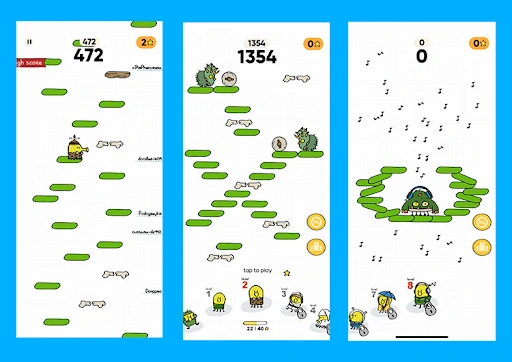
This one is probably the most playful and original art style for 2D games. Sometimes, designers use hand-drawn sketches of objects and characters before importing them as digital assets.
Since we usually doodle when our attention is focused on another task, the final results often look pretty abstract and somewhat weird. However, this adds more uniqueness and originality to your projects.
You may apply doodle art for any action, arcade, or even puzzle games. This art style goes well with some fun scenarios and positive characters — even the villains in such games also look quite comic and not scary at all. ToonTown and Doodle Jump are the perfect examples of that.
Cel Shading

This art style is younger than the others and it’s quite an interesting one. The main concept of this art style is trying to make three-dimensional characters and objects look flat or paper-like. For better understanding, take a 3D model of any object and “put it on paper” from just one angle. It maintains a high level of detail yet with no volume.
This is a perfect choice for creating captivating characters and environments. This may seem a bit more time-consuming than creating other 2D art styles, but it’s also quite inspiring and rewarding. If you want to look at some of the most famous examples of cel shading in games, try X-Men Legends or Ultimate Spider-Man.
Cutout Art

The name speaks for itself: designers try to imitate paper objects and characters and put them into new surroundings. You may even use an actual cutout or draw it on your computer before making it a digital asset. It all remains static in the game, but you can change the position of objects to start the motion.
For example, it’s an excellent option for puzzle and adventure games for kids. It’s more playful and engaging to younger players because cutouts are something they used to do in real life. Some of the main examples are Paper Mario and Sonic 4.
Flat Art

Flat art is an eye-catching style used in action, horror, platformer, and many other games. It’s not just flat objects and characters with a simple background. Here, some images overlap with others to create a sense of volume. You can especially see it in the games’ locations: forests, mountains, and valleys become more realistic and “deep.”
Flat art offers great opportunities for creativity. Compared to monochromatic art, where you can use one or two colors and not pay much attention to the surroundings, flat art is more complex. Create tons of combinations, overlap objects in the most unpredictable way, and immerse players in a truly unique environment that they would love.
If you want to see and play some outstanding flat art games, try Eliora — the game our team made the art for. Here, we used rather minimalistic flat art elements that significantly represent the vibe and atmosphere of the Ancient Roman Empire. We produced this art from scratch, so we were involved in every step of 2D art style development.
If you want to see more game visuals and try it yourself, follow this link and enjoy!
2D Art Style Trends in 2026
The 2D art landscape has shifted significantly since this guide was first published. Here’s what’s dominating studios and storefronts right now:
HD-2D (Hybrid Pixel Art)
Square Enix’s Octopath Traveler popularised this style, and it hasn’t slowed down. HD-2D mixes pixel art sprites with richly rendered 3D backgrounds, giving games a nostalgic feel with modern production values. Expect to see more indie RPGs lean into this in 2026.
Anime-influenced 2D
Anime aesthetics are a dominant force in 2026, crossing into action RPGs, visual novels, and even mobile puzzle games. The style’s versatility – from dark narrative tones to bright casual designs – makes it one of the most commercially flexible choices available.
Isometric 2D
Isometric art is enjoying a strong revival, particularly in roguelikes, strategy games, and casual RPGs. Games like Balatro have shown that distinctive, stylized 2D art can outperform polished 3D in terms of player engagement and virality.
Cozy and lo-fi aesthetics
The cozy game genre is one of the fastest-growing segments in 2026. Warm palettes, soft line weights, and hand-painted textures define this look. It translates exceptionally well to mobile and suits co-op and casual audiences.
2D/3D hybrid
Studios are increasingly blending 2D and 3D elements within a single game – using flat 2D characters against 3D environments, or vice versa. Games like Dispatch and Ocean Keeper demonstrate how this hybrid approach creates visual variety without dramatically increasing production costs
THE BEST 2D DAME ART DEVELOPMENT SERVICES THAT YOU CAN CHOOSE
Creating 2D game art is a critical and gratifying part of game development. By choosing appropriate design and styles for your game’s world, you’ll not only create a pleasant aesthetic but also enhance the overall gaming experience and attract more potential players.
If you or your studio lacks experience in concept art and design, you can always outsource these tasks. Our team at Whimsy Games offers high-quality concept art and 2D design services for your games.
What can outsourcing teams help you with?
Character design
Vehicle, weapon, and object design
Location visualization
Spatial level design
One of the main perks of ordering concept art is that teams work really fast and deliver the best ideas and results as soon as possible. It’s more cost-effective than creating final designs and gives you the freedom to choose which concept to work with.
Here are some benefits you’ll get from working with an outsourcing company:
- Low risks and better results
- Competitive pricing
- Unlimited ideation
- Access to professional artists
- Flexibility of teams
- Enormous time savings
Another problem that might occur is security doubts. However, you can quickly address them by defining a clear schedule and arranging all legal obligations to protect your intellectual property. There are, however, some minor moments that you need to be aware of. It can sometimes be challenging to ensure proper communication, as the outsourcing team can work anywhere.
Finally, let’s look at some of the main points that you might consider while choosing an outsourcing company for cooperation:
Extensive portfolio with successful cases — the core aspect of hiring game development outsourcing teams. You need to see what the company has done so far and whether anyone liked it. This way, you know you can trust your ideas to them and be sure you’ll get what you want.
Experience working with the leading game publishers is an important trust factor for many companies. Check out the publishers’ feedback and whether they recommend working with a company to ensure it’s a worthy one.
Wide range of services — big, successful companies usually offer a variety of services: 2D game art design, 3D game art, animation, concept art production, etc.
Active online presence — it’s important for such companies to spread the word about their services to drive more clients. Check out their social media pages, read testimonials on their website or review platforms, and see if they reply to comments or questions.
A large number of specialists — usually, outsourcing companies that offer multiple services require enough staff for the due project completion for all of their clients. This way, you’ll be sure there won’t be any problems with deadlines and/or urgent tasks.
There’s a wider list of decision-making factors that vary from company to company. Keep these major points in mind, and you’ll never pick the wrong outsourcing vendor for your projects!
CONCLUSIONS AND OUTLOOK
As you can see, there are plenty of cool, unique 2D video game art styles that you could use for your project. Two-dimensional art is easier to produce and more cost-effective than 3D art, and it lets you develop stunning concepts much faster.
2D is a perfect choice for time-killing and casual games, and it’s ideal for kids’ games. It’s still a worthy area of game development — with some impressive art and extraordinary mechanics, you’ll be able to beat the best-selling 3D projects.
We at Whimsy Games have immense expertise in creating enjoyable 2D game art. If you’re not satisfied with your creativity or want to outsource any 2D art production, we’re here to help. You can always reach out to us — we’ll work on something great together!